Rajasthan in 7 Days: The Classic Circuit Itinerary
Seven days in Rajasthan forces one honest decision: you cannot have both Jaisalmer and a sane pace. This route chooses sanity — four bases, no 600-km days, and the desert deferred to your next trip (or to the 10-day version). Every night’s bed is planned; every drive is under five hours.
The arithmetic behind that decision is unforgiving. Jaisalmer is a road dead-end: whatever you do out there, you come back east along the same road, and that costs the better part of a day in each direction. Force it into a week and you spend two of your seven days looking at scrub through a windscreen, then gut the middle of the trip to pay for them. Leave it out and what remains — Jaipur, Pushkar, Jodhpur, Udaipur, with Ranakpur caught in transit — settles into a shape that actually breathes.
The shape of the week
| Day | Where | Sleep in |
|---|---|---|
| 1 | Arrive Jaipur, old city evening | Jaipur |
| 2 | Amber Fort + Pink City | Jaipur |
| 3 | Drive to Pushkar (3h), lake & ghats | Pushkar |
| 4 | Drive to Jodhpur (3h), stepwell quarter | Jodhpur |
| 5 | Mehrangarh + Blue City, evening market | Jodhpur |
| 6 | Drive to Udaipur via Ranakpur (5h total), sunset boat | Udaipur |
| 7 | City Palace + Jag Mandir, depart (or +1 night) | Udaipur |
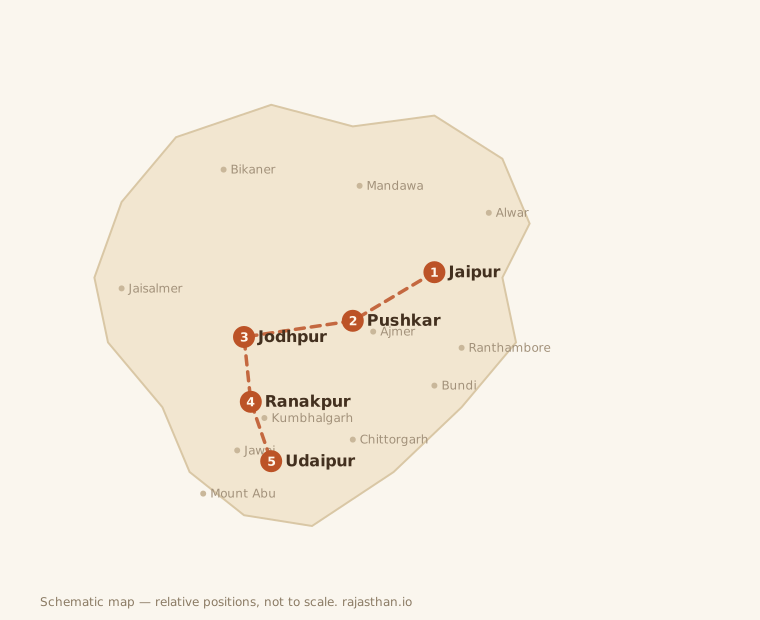
Four beds, seven nights, and the route runs one way — north-east to south-west, never doubling back. That matters more than it sounds. Every transfer lands you somewhere new by early afternoon, so no travel day is a wasted day, and each drive is short enough that you arrive wanting dinner rather than a lie-down. The two cities that reward a second night, Jaipur and Jodhpur, get one. Pushkar, which does not, gets a single night in the middle where it functions as both a destination and a rest stop.
Day by day
Day 1 — Land in Jaipur
Afternoon · Arrive. Fly into Jaipur, or take the morning train from Delhi (~4.5 hours, and a far better introduction to India than the highway). Check in, eat a thali properly rather than quickly, and let the afternoon heat pass.
16:30–17:30 · Hawa Mahal. The five-storey honeycomb façade is a screen, not a building — it was built so palace women could watch the street unseen. Look at it from the pavement opposite, where the whole thing is legible, then decide whether the interior is worth the climb.
17:30–19:30 · The old city on foot. Drift through Bapu Bazaar and Johari Bazaar as the shopfronts light up: block-printed cotton, lac bangles, jootis, and the smell of frying kachoris. Buy nothing on day one. Early night — Day 2 starts at dawn.
Day 2 — Jaipur’s big day
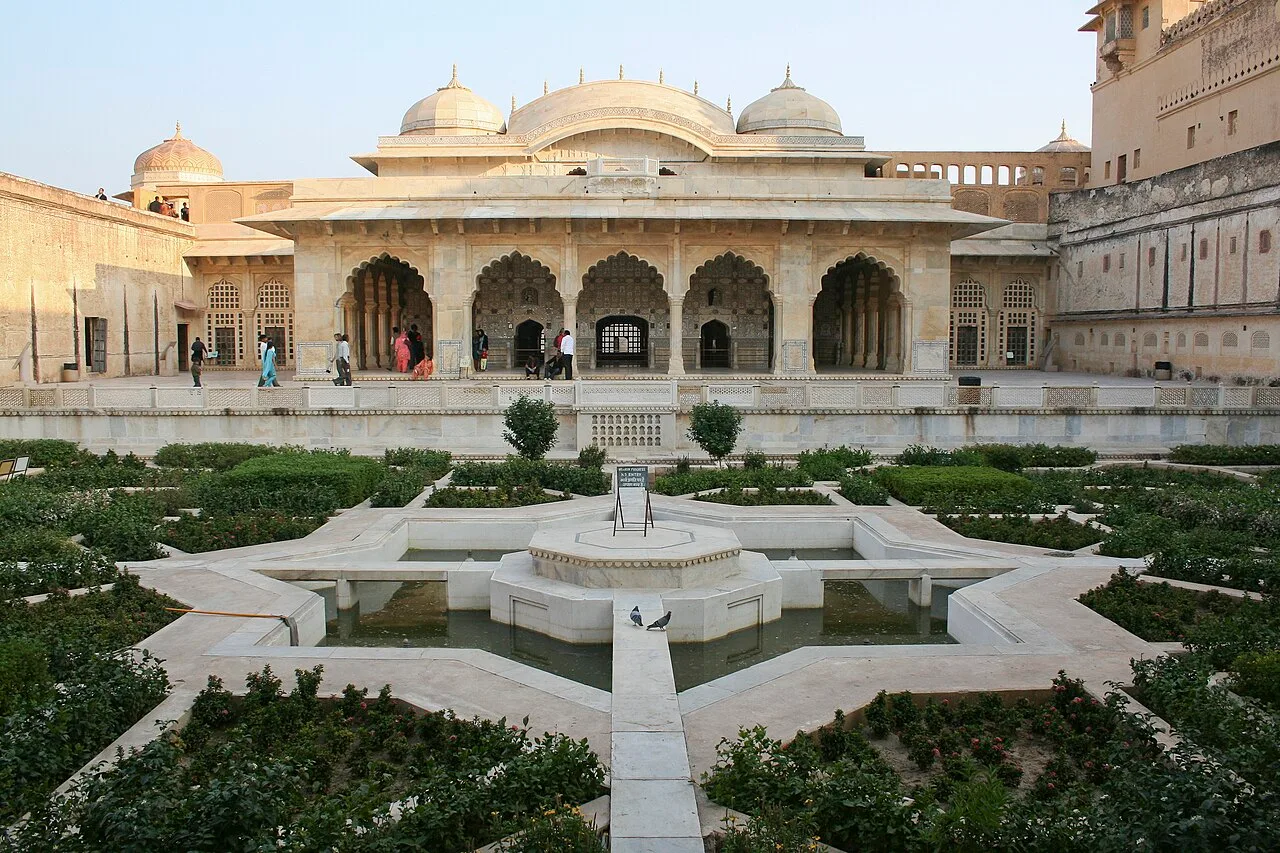
8:00–11:00 · Amber Fort. Be at the gate when it opens. Amber is a hillside of interlocking courtyards, and the sequence is the pleasure: the Diwan-i-Aam, then the Ganesh Pol, then Sheesh Mahal, whose mirrored ceiling is designed to turn a single candle into a constellation. Three hours is right, and the crowd doubles after ten. Full detail in the Amber Fort guide.
11:00–12:00 · Panna Meena ka Kund and Jal Mahal. The stepwell below Amber is a five-minute stop of pure geometry; Jal Mahal, marooned in Man Sagar lake, is a photograph from the roadside and nothing more. Treat both as punctuation.
12:30–14:30 · Lunch and the heat. Retreat indoors. This is the part of the day the itinerary is designed to waste.
15:00–17:00 · City Palace and Jantar Mantar. They share a wall, so do them together: the palace for the textile and armoury galleries and the four painted seasonal doorways of Pritam Niwas Chowk, then the observatory next door, where the instruments are buildings and the sundial keeps time to two seconds.
17:30–18:45 · Nahargarh sunset. Up the ridge for the whole pink city laid out flat below. Go early enough to get a wall seat. This compresses our 2-day Jaipur plan — steal its timings.
Day 3 — To Pushkar
9:00–12:00 · Drive to Pushkar, about 3 hours on good highway. An easy morning; you will be checked in before lunch.
14:00–16:00 · Brahma Temple and the bazaar. One of very few temples anywhere dedicated to Brahma, and the reason the town exists. Then the single bazaar street, which sells more genuinely interesting things than its reputation suggests. Pushkar is strictly vegetarian and alcohol-free — do not fight it, it is part of why the town feels the way it does.
17:30–19:00 · The ghats at dusk. Fifty-two ghats step down into the lake and the bells start as the light goes. Shoes off before you reach the water. You will be offered a flower blessing and then a “donation” figure; decide in advance what you are willing to give, or decline politely at the top of the steps rather than halfway down them. More context in the Pushkar guide.
Day 4 — To Jodhpur
6:30–8:00 · Savitri temple (optional). The hilltop climb above town for sunrise over the lake, or the ropeway if the stairs do not appeal.
9:30–12:30 · Drive to Jodhpur, about 3 hours south-west. The land dries out visibly through the window.
15:00–18:00 · The stepwell quarter. Toorji ka Jhalra, excavated out of centuries of silt and now the centre of the nicest few lanes in the old city: café tables, sandstone terraces, kids jumping into the water, and golden-hour geometry that photographs itself.
19:30 · Rooftop dinner under the floodlit fort, which sits 120 metres above you and never stops being the view.
Day 5 — Jodhpur’s big day
9:00–13:00 · Mehrangarh. Give it the whole morning. The fort is entered by a switchback ramp built to break a cavalry charge, and inside are the palanquin and howdah galleries, the Phool Mahal, and ramparts that drop straight into the blue houses. The audio guide is genuinely great — see the Mehrangarh guide.
13:00–14:00 · Jaswant Thada. The white marble cenotaph five minutes downhill, quiet after the fort, with the best photograph of Mehrangarh from across its little lake.
16:00–18:00 · The Blue City lanes. Get properly lost in Navchokiya, the oldest and bluest quarter, as the light softens the indigo.
18:30–20:00 · Sardar Market. The clock-tower bazaar at full volume: spices, silver, textiles, and the makhaniya lassi verdict, which everyone delivers with unearned confidence after one glass.
Day 6 — The beautiful drive
8:30 · Leave Jodhpur. Jodhpur to Udaipur is 4.5–5 hours via Ranakpur, and the timing is not casual. Ranakpur admits general visitors only after midday — mornings belong to worship — so aim your arrival at noon, not earlier. Arriving at ten means sitting in a car park.
12:00–13:30 · Ranakpur. A 15th-century Jain temple where 1,444 marble pillars hold up a forest of domes, no two carved alike. Leather is refused at Jain temples: belts, bags, camera straps. Leave it in the car rather than discovering the rule at the door. The Ranakpur guide covers the dress code and camera ticket.
13:30–16:30 · Into the Aravallis. Lunch near the temple, then the winding road down to Udaipur — the prettiest driving of the week.
17:00–18:30 · Sunset boat to Jag Mandir. Straight from check-in to the jetty if you can. Out across Pichola, an hour on the island palace, and a return cruise pointed at a gilded City Palace.
Day 7 — Udaipur, then home
8:30–12:00 · City Palace. Rajasthan’s largest palace complex, and it climbs: mirrored chambers, the peacock mosaics of Mor Chowk, and lake views that improve on every level.
12:30 · Last rooftop lunch, then out via Udaipur’s airport. With a bonus night, add the Monsoon Palace sunset and the Bagore ki Haveli dance show — see the 3-day Udaipur plan.
Where you sleep
- Jaipur, nights 1–2 — inside or just outside the old city walls. Staying near Hawa Mahal and the bazaars means your evenings happen on foot. The quieter alternative is Bani Park or Civil Lines, ten minutes out, with garden havelis and easier parking. Avoid the highway hotels near the airport; they save nothing but time you wanted to spend walking.
- Pushkar, night 3 — a lake-facing guesthouse near the ghats. The whole point is waking to temple bells and reaching the water in four minutes. Camel-camp properties out on the fairground road are for festival week only.
- Jodhpur, nights 4–5 — the old city, near the clock tower or Toorji ka Jhalra. A rooftop with the fort in view is not a splurge here, it is the standard product, and it is what the city is for. The newer hotels in Ratanada are comfortable and put you in a taxi every evening.
- Udaipur, night 6 (and 7) — Lal Ghat or Hanuman Ghat. East bank for proximity to the palace gate, west bank across the footbridge for the better view of the palace and slightly lower prices. Book the lake-view room early; it is the one bed on this route that genuinely sells out.
The honest trade-offs
- Jaisalmer: adding it means two long travel days and a gutted middle. If the dunes are non-negotiable, take the 10-day route or fly one leg — but don’t force it into 7 days.
- Direction: the route runs west-then-south so it ends in Udaipur — the best city to end in, with good onward flights and the gentlest last morning.
- Drives: hire one car and driver for the circuit (standard practice, priced per km/day) — the Pushkar and Ranakpur legs are where trains can’t take you. Trains work fine for Jaipur↔Jodhpur if you prefer rails, but then you lose Ranakpur, which is half the reason Day 6 exists.
What to cut, what to add
Down to five days? Drop Jodhpur, not Udaipur: Jaipur, Pushkar, Udaipur is a coherent short trip and the 5-day route lays it out. Cutting Udaipur to keep Jodhpur leaves you ending on a long drive to an airport you did not want.
A spare eighth day? Give it to Udaipur and run the Kumbhalgarh loop — a 36-km fort wall in the Aravallis, paired with a second, unhurried look at Ranakpur in its afternoon window. Alternatively, break the Jaipur–Pushkar drive with a night in Bundi, which has the painted palace and none of the crowds.
Two spare days? Then the honest answer is the 10-day route, which adds Jaisalmer properly instead of grafting it on.
Common mistakes
- Running Day 6 in reverse, or leaving Jodhpur at 6 am. Ranakpur does not admit general visitors before midday. Arriving early buys you a wait, not a head start.
- Trying to bolt Jaisalmer onto Day 5 or 6. It is 5 hours each way from Jodhpur and there is no loop road onward. You would be adding a full day of backtracking to a week that has none spare.
- Starting Amber Fort at 10:30. By then you are in a queue in the sun for the interesting parts. The single highest-value decision in Jaipur is the alarm clock.
- Booking a morning flight out of Udaipur on Day 7. It deletes the City Palace and turns your best city into a transit stop. Fly out after 15:00 or add the extra night.
- One-nighting Jodhpur to buy a day elsewhere. Mehrangarh alone is a morning; the Blue City and the market are the evening. One night gets you neither properly.
- Booking four separate taxis for four legs. One driver for the circuit is cheaper, and he waits at Ranakpur while you are inside.
When to run it
October–March. Shoulder months (September, early April) work with earlier mornings. Peak December–January needs bookings weeks ahead — this circuit is popular for good reason, and January adds a genuine chill after sunset in Jodhpur and on the Udaipur boat, so pack a layer.
April to June does not kill the route, it rearranges it. Shift every morning start an hour earlier, treat 12:00–16:00 as indoor time everywhere, and take the earlier boat in Udaipur rather than the latest one. The Day 6 drive is the easy day in a heatwave, because you are in a car with the air-conditioning on for most of it. Monsoon (July–September) is quieter and cheaper, the Aravalli leg into Udaipur is at its most beautiful, and the trade is haze and occasional washed-out afternoons. See the best time to visit guide.
Questions people actually ask
Can I add the Taj Mahal to this week? Only by rearranging the start: Delhi, Agra, then Jaipur, which is the Golden Triangle route. Bolting Agra onto the end from Udaipur is 12 hours in the wrong direction. And note that the Taj closes on Fridays — that single fact has ruined more Indian itineraries than any other.
Car and driver, or trains? Car, for this route. Trains are excellent on the trunk lines but Pushkar and Ranakpur are not on them, and Day 6 is the day most people remember. If budget is the constraint, train Jaipur→Jodhpur and hire a car from there.
Is one night in Pushkar enough? Yes, unless you are there for the camel fair in November, when the town becomes an entirely different and much larger event. Otherwise Pushkar is a sunset-and-morning town.
Could I reverse the route and end in Jaipur? You could, but you would finish with the loudest city and the worst last morning. Ending in Udaipur means your final day is a palace and a rooftop lunch, not a traffic jam.
Where this fits
- Jaipur, Jodhpur and Udaipur guides for neighbourhood and food detail
- Getting around Rajasthan — trains, drivers, and what a per-km quote actually includes
- Rajasthan in 10 days if you can find two more days and want the desert