3 Days in Udaipur: The Complete Itinerary
Three days is the perfect Udaipur allocation: two for the lake city itself, one for the day trip into the Aravallis that many travellers rate the best single day of their entire India trip. Here’s the sequence that makes it all fit gracefully.
The reason three works and two does not is the third day. Udaipur’s own sights are compact — you can walk between most of them — and a determined visitor covers the palace, the boat and the ghats in a day and a half. What you cannot compress is the loop out to Kumbhalgarh and Ranakpur, which is a full sunrise-to-dark commitment on hill roads. Two days means choosing between the city and the mountains. Three means having both, in the right order.
The shape of the trip
| Day | Where | Sleep in |
|---|---|---|
| 1 | Jagdish Temple, City Palace, Jag Mandir boat, folk-dance show | Udaipur old city |
| 2 | Ambrai Ghat, Saheliyon ki Bari, Fateh Sagar, Monsoon Palace sunset | Udaipur old city |
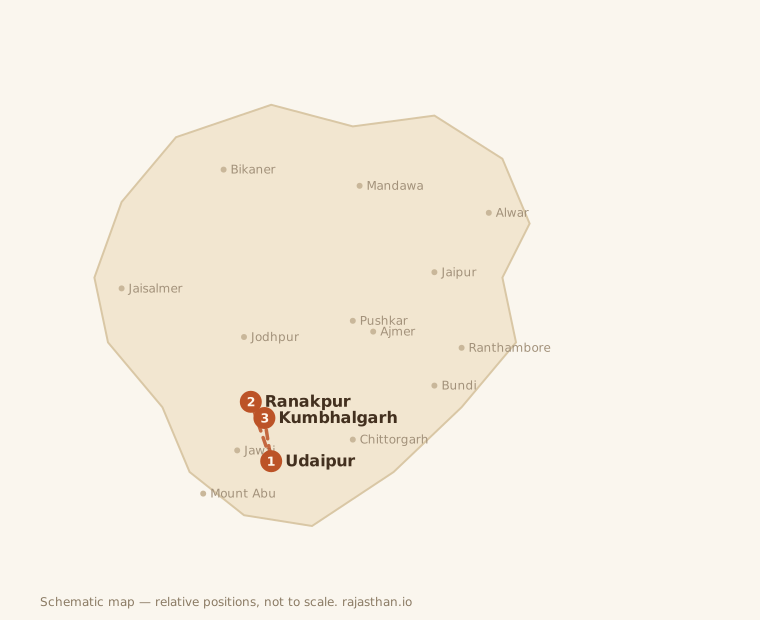
| 3 | Kumbhalgarh and Ranakpur loop (~200 km round trip) | Udaipur old city |
Three nights, one bed, no packing. Note that Day 3 is the one with a hard timing constraint attached, and it is the reason the day trip sits last rather than first: you want to have already seen the city before you spend twelve hours away from it, and you want your driver booked with a day’s notice.
Day 1 — The palace and the lake
8:30–9:00 · Jagdish Temple. Start where the city does. The working 17th-century Vishnu temple sits at the top of a steep stair two minutes from the palace gate, and the morning bell-and-incense hour is when it is a temple rather than a monument. Shoes off at the bottom; the brass Garuda shrine faces the sanctum.
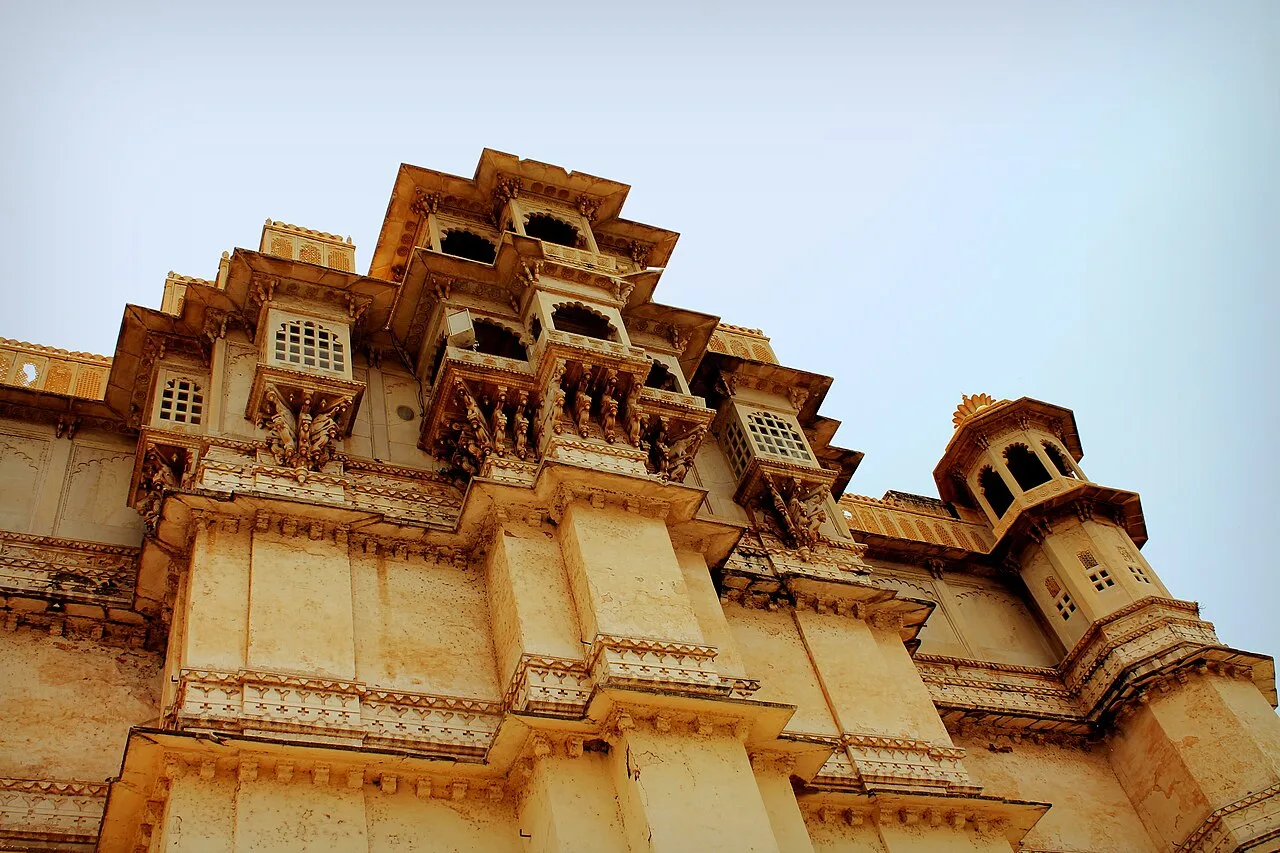
9:00–12:30 · City Palace. Rajasthan’s largest palace complex, and it deserves a slow half-day rather than a march. It is not one building but a stacked accumulation of four centuries of Mewar additions, and the route through it climbs: mirror-and-glass chambers, the peacock mosaics of Mor Chowk, the pierced-screen balconies of Zenana Mahal, and lake views that improve on every level until you are looking straight down on Jag Niwas. Buy the museum ticket, take the audio guide, and give it three hours. The gallery of Mewar miniature paintings near the exit is worth the last twenty minutes.
13:00–15:30 · Lunch and the old-city lanes. Eat on a rooftop near Gangaur Ghat, then drift downhill — miniature-painting studios where you can watch squirrel-hair brushwork happen, silver shops, bookbinders, and lassi stops between them. This is also the block when the heat peaks, and the lanes are narrow enough to stay shaded.
16:00–17:30 · Boat to Jag Mandir. The late-afternoon boat from the palace jetty at Rameshwar Ghat: out across Pichola, an hour on the island palace with its carved elephants and garden courtyard, and a return cruise pointed at a sunset-gilded City Palace. This is the best hour in Udaipur and it is worth paying for the later departure. Details, including which jetty and what the ticket structure looks like, are in our Jag Mandir guide.
19:00–20:00 · Dharohar folk-dance show at Bagore ki Haveli. Buy tickets in advance from the ghat-side office; it sells out, particularly in December. Ghoomar, the fire dance, and the astonishing bhavai act in which a woman balances a rising stack of brass pots on her head while dancing on broken glass — all in a candle-lit haveli courtyard. Forty-five minutes and no padding.
Day 2 — Ridges, gardens, ghats
8:30–9:30 · Ambrai Ghat. Cross the footbridge to the Hanuman Ghat side for the classic across-the-water view: City Palace, Lake Palace and the ghats stacked in one frame in soft morning light. Locals are washing, kids are swimming, and nobody is trying to sell you anything before ten.
10:00–11:30 · Saheliyon ki Bari and Fateh Sagar. The “garden of the maidens” was built for the queen’s forty-eight attendants — lotus pools, marble elephants and fountains originally driven entirely by gravity from the lake above. Then drive the promenade around Fateh Sagar, the second and breezier lake, where Udaipur goes in the evening.
12:00–15:00 · Lunch, rest, or shopping. Shilpgram, the craft village west of Fateh Sagar, fills this slot well if textiles and folk craft interest you — it is a reconstructed set of village dwellings from across western India with resident artisans. Otherwise, be horizontal.
16:00–18:00 · Sajjangarh, the Monsoon Palace. Up the winding ridge road inside the wildlife sanctuary — you cannot take your own vehicle to the top from the sanctuary gate, so budget for the shuttle. The palace itself is a shell; you come for the panorama, with the lakes silvering below and Aravalli ranges stacked to the horizon. Arrive 90 minutes before sunset to claim a parapet spot, because everyone in Udaipur has the same idea.
19:30 · Dinner with a view. Ambrai’s lakeside tables or a rooftop at Hanuman Ghat. The floodlit palace across black water is the city’s closing argument, and it wins.
Day 3 — The Kumbhalgarh and Ranakpur loop
The Aravalli day trip: Kumbhalgarh Fort, whose 36 km wall is popularly called the Great Wall of India, and Ranakpur, a 15th-century Jain temple of 1,444 marble pillars, no two carved alike. Roughly 200 km round trip on winding hill roads. Hire a car and driver for the whole day.
The order is not negotiable, and this is the single most important sentence on this page: Ranakpur admits general visitors only after midday, because mornings belong to worship. Run the loop fort-first or you will arrive at a closed door and have to choose between waiting three hours and driving home having seen a car park.
8:00 · Leave Udaipur. Earlier in summer. It is about 84 km to Kumbhalgarh and the hill road takes 2–2.5 hours, which is slower than the distance suggests and correctly so.
10:15–13:00 · Kumbhalgarh. Walk a stretch of the great wall from the main gate — twenty minutes out along the ramparts gives you the serpentine view without a trek — then climb to Badal Mahal, the cloud palace at the top. It is 30–40 minutes of steps and everybody sweats. Inside the walls are several hundred temple ruins, most of them silent.
13:00–14:30 · Drive to Ranakpur through the hills, about 50 km and an hour and a half. Eat on the way or at the restaurants near the temple.
14:30–16:00 · Ranakpur. A forest of columns under 80 domes, with light moving through the lattices all day. Leather is refused at Jain temples — belts, bags, camera straps, shoes — so leave it in the car rather than discovering this at the entrance. Modest dress; cameras normally need their own ticket.
16:00–19:00 · Back to Udaipur, about 90 km and much of it faster road. Home for a farewell rooftop dinner. The turn-by-turn version is in our Udaipur to Kumbhalgarh guide.
Where to sleep
All three nights in the old city, and the choice is really between two banks of the same lake.
- Lal Ghat / Gangaur Ghat — the east shore, where the guesthouses and boutique havelis are. You are two minutes from Jagdish Temple and the palace gate, and Day 1 and Day 2 both start on foot. Rooftop breakfasts face the water.
- Hanuman Ghat, across the footbridge — quieter, slightly cheaper, and it has the better view of the palace rather than from it. Ambrai Ghat is at the bottom of your lane.
- Out-of-town lake resorts are lovely and wrong for a three-day trip. Every taxi ride you add is time subtracted from the lanes.
Book the lake-view room early. It is the one bed in southern Rajasthan that genuinely sells out, and the difference between a room with a window on Pichola and one facing an alley is most of what you came for.
What to cut, what to add
Two days instead of three? Protect the day trip. Drop Day 2’s gardens and Shilpgram entirely, move the Sajjangarh sunset onto the end of Day 1 (tight, but it works if you take the earlier boat), and run the Aravalli loop on Day 2. Cutting the day trip to keep a garden is the wrong trade.
One day only? Different plan — City Palace, boat, ghats, and nothing else. See the 1-day Udaipur itinerary.
A fourth day? Two good options. Chittorgarh is about two hours east and is the largest fort in India, with a story of siege and self-immolation that gives the Mewar palaces their emotional context — the Chittorgarh from Udaipur guide has the timings. Or go the other way to Jawai, two to three hours south-west, for leopards on granite hills and a genuine change of pace.
Common mistakes
- Running Day 3 in reverse. Ranakpur first means arriving before it admits visitors. It is the most common ruined day in southern Rajasthan.
- Wearing a leather belt to Ranakpur. Leather is refused at the door. So are leather camera straps and handbags, which catch people out more often than shoes do.
- Booking the day trip through a hotel desk the night before at 10 pm. It is arrangeable, but you will get whatever driver is left. Ask on arrival.
- Treating the City Palace as a one-hour stop. People allow sixty minutes, reach the third level, realise, and then rush the best part.
- Reaching Sajjangarh at sunset. The road up is slow and the parapet fills. Ninety minutes early or don’t bother.
- Staying outside the old city to save money. Udaipur is a walking city. Give that up and you have bought a different, worse trip.
Seasonal notes
October to March is the reliable window, with December and January cool enough to want a layer on the boat after dark. Late monsoon, August and September, is Udaipur’s underrated season: the lakes brim, the hills go green, and Day 3’s drive is at its most beautiful — with the caveat that Kumbhalgarh’s panorama occasionally disappears into mist, so check the forecast.
April to June needs the plan inverted rather than abandoned. Start Day 1 at 8:00, take the 4 pm boat rather than the 5 pm one, and treat the middle of the day as off-limits. On the day trip, leave Udaipur by 7:00; the Badal Mahal climb in May heat is genuinely unpleasant, and the hills run a few degrees cooler than the city but not enough to change the arithmetic. See the best time to visit guide.
Questions people actually ask
Is the Lake Palace visitable? Not unless you are staying there or have a dinner booking, and dinner reservations for non-residents are limited and seasonal. Jag Mandir is the island you can actually land on, which is why it is on Day 1.
Which boat trip should I take? The sunset departure from the City Palace jetty, which includes the Jag Mandir stop. The cheaper daytime round-trip skips the island and the light.
Can I do Kumbhalgarh by bus? Technically. Practically no — the connections devour the day and you will miss Ranakpur’s afternoon window. A car and driver for the day is standard practice here and is priced for the round trip.
Is three days too long if I don’t like museums? No, because only one of the three days is museum-shaped. Days 2 and 3 are outdoors almost entirely.
Where this fits
- Full neighbourhood and food detail in the Udaipur guide
- City Palace guide for the complex in depth
- Ranakpur Jain temple guide — including the midday rule and the dress code
- Udaipur in 1 day if you are only passing through
- Rajasthan in 5 days — Jaipur, Pushkar and Udaipur, ending here
- Rajasthan in 7 days, which reaches Udaipur via Jodhpur and catches Ranakpur in transit
- Mount Abu — about three hours away, for the Dilwara temples
- Chittorgarh — the obvious day-four addition