Udaipur Travel Guide: Lakes and Palaces
Udaipur runs at a different speed to the rest of Rajasthan. Where Jaipur and Jodhpur are cities with sights, Udaipur is a mood with a lake in the middle — best absorbed from a rooftop at dusk when the palace lights come on and the water holds them. Give it two nights minimum; three lets you add the best day trip in the state.
Why it feels different
The other great Rajput capitals were built by rulers who came to terms with the Mughals. Udaipur was founded in 1559 by Maharana Udai Singh II precisely because his ancestors would not — a new capital in a defensible bowl of the Aravallis, established as the old Mewar stronghold at Chittorgarh came under Mughal siege. The Sisodia rulers of Mewar held out longer and conceded less than any other Rajput house, and the city they built is quieter and more inward than Jaipur, with its grandeur turned toward the water rather than the parade ground.
The heart of it: Lake Pichola
Everything orbits the lake — itself older than the city, dug in the fourteenth century by a grain merchant and enlarged by Udai Singh when he moved his capital here.
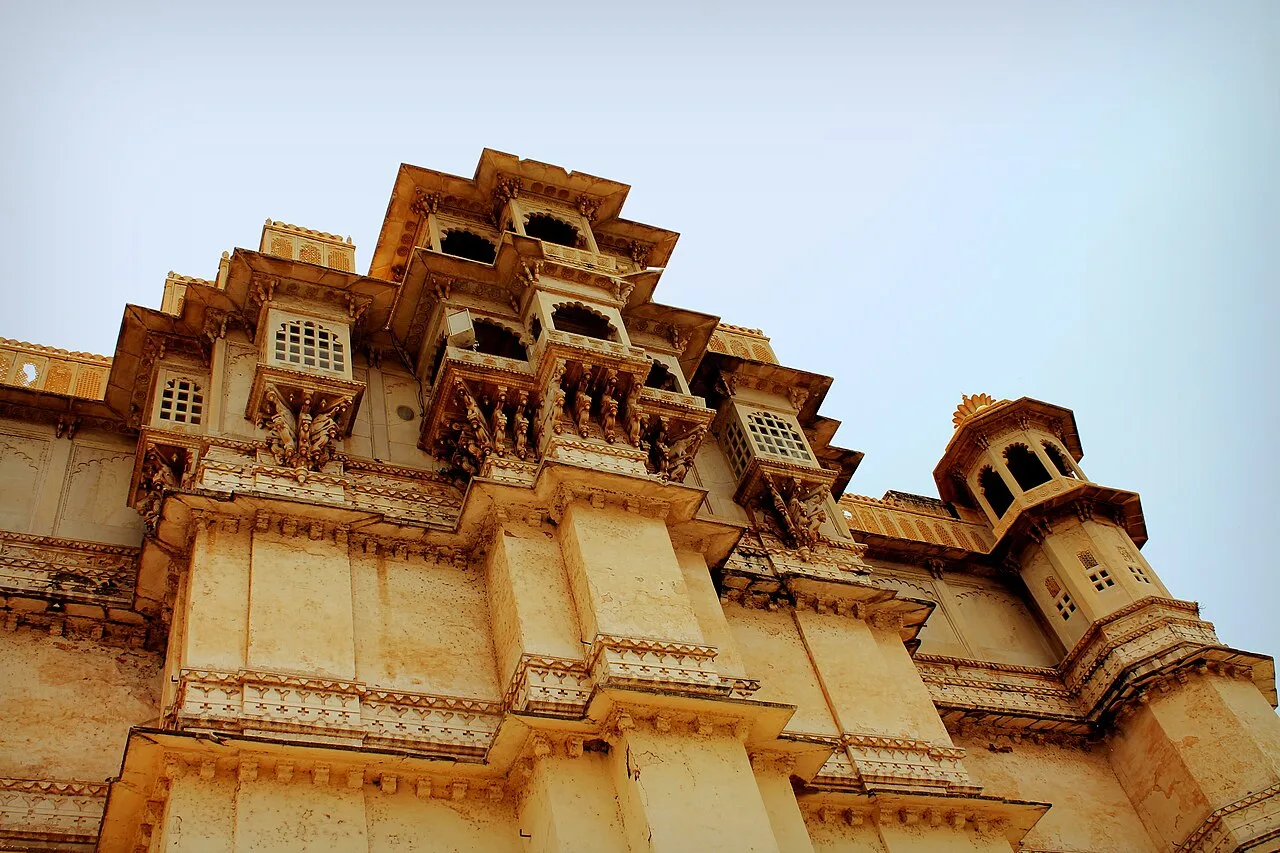
City Palace rises along the eastern shore — a 400-year accretion of courtyards, mirror halls and balconies stacked into Rajasthan’s largest palace complex, added to by twenty-two successive Maharanas. Allow a half day. The route runs one way through a deliberately confusing sequence of narrow stairs and small doors, which is the point: it was built to be defensible from inside. Look for Mor Chowk, where three peacocks are worked in coloured glass mosaic; the Zenana Mahal women’s quarters; and Amar Vilas at the top, where hanging gardens open onto the best jharokha views over the water. The separately ticketed Crystal Gallery — a Victorian order of English crystal furniture that sat unpacked for decades — is expensive and genuinely odd; go if decorative arts are your thing, skip it otherwise. Our City Palace guide walks the route room by room.
From the palace jetty, take the boat ride to Jag Mandir — the island palace where, so the story goes, the young prince who became Shah Jahan took refuge and stored ideas he later spent on the Taj Mahal. Note the row of carved stone elephants at the landing. The late-afternoon boat, timed so you cruise back toward a sunset-lit city, is the single best hour in Udaipur. (More detail in our full Jag Mandir guide.) The other island, the Lake Palace, is now a hotel — guests only, admired from the water.
The rest of the essential list
- Jagdish Temple — the working 17th-century temple a few steps from the palace gate, up a flight of steps guarded by stone elephants; go when the bells start, and stand at the back rather than in the middle. Twenty minutes.
- Bagore ki Haveli at Gangaur Ghat — modest museum by day; at dusk it hosts the Dharohar folk-dance show, the one cultural performance in Rajasthan worth planning an evening around. Buy tickets early; it sells out. The finale, a dancer balancing a tower of clay pots, is not a trick photograph.
- Sajjangarh (Monsoon Palace) — the white palace on the ridge west of town, begun in 1884 and never finished. Ignore the sparse interior; you’re there for the sunset panorama over lakes and Aravallis. It sits inside a wildlife sanctuary, so you usually transfer to a shared vehicle at the gate, and the single access road jams at sunset — arrive a good hour early.
- Fateh Sagar Lake and Saheliyon ki Bari — a breezier lakefront and a fountain garden built for the ladies of the court, its fountains still run by gravity alone; pleasant fillers for a second day.
- Ambrai Ghat — the classic across-the-water view of City Palace, particularly at first light when the bathers arrive and the tourists haven’t.
- Ahar Cenotaphs, three kilometres east — hundreds of royal memorials in a field, almost empty of visitors, and the most atmospheric half-hour in the city. This is a cremation ground; walk it quietly.
Two days, in the right order
| Day 1 | |
|---|---|
| 07:00 | Ambrai Ghat and the ghats at first light, before the heat |
| 09:30 | City Palace, entering as it opens and working upward |
| 13:00 | Lunch and a slow afternoon — this city rewards sitting still |
| 16:30 | Boat to Jag Mandir, returning into the sunset |
| 19:00 | Dharohar show at Bagore ki Haveli, then dinner over the lake |
| Day 2 | |
|---|---|
| 08:00 | Jagdish Temple as the morning worship gets going |
| 09:00 | Old city lanes — Hathi Pol for miniature painting, Bada Bazaar |
| 11:30 | Saheliyon ki Bari and a walk along Fateh Sagar |
| 14:00 | Ahar Cenotaphs, quiet and empty |
| 16:30 | Sajjangarh for sunset — leave early, the road backs up |
The 3-day Udaipur itinerary adds the day trip below and paces the whole thing properly.
The day trip that outranks the sights
With a third day, drive the loop to Kumbhalgarh Fort and Ranakpur’s Jain temple — a Great-Wall-scale rampart in the hills and a 1,444-pillar marble prayer in the forest, two hours from town. It’s the best single day out in Rajasthan; we’ve written it up turn-by-turn in the Kumbhalgarh from Udaipur guide.
Two constraints shape the day, and both are non-negotiable. Ranakpur admits general visitors only after midday — the morning belongs to worship — so the loop has to run Kumbhalgarh first, Ranakpur second. And leather is refused at Jain temples: belts, bags, shoes, watch straps, camera straps. Leave it in the car rather than arguing at the door. See the Ranakpur guide for what to expect inside.
Kumbhalgarh itself is a two-hour visit if you climb to Badal Mahal at the top, and the walk along the ramparts — thirty-six kilometres of them, the longest continuous wall in India — is what people remember, not the palace.
Other day trips, in order of how well they repay the drive:
| Trip | Each way | Verdict |
|---|---|---|
| Kumbhalgarh + Ranakpur | ~2–2.5 hrs | The one to do |
| Chittorgarh | ~2 hrs | Vast, sombre, needs a car inside the fort |
| Eklingji + Nathdwara | ~1 hr | Living temples; opening windows are limited, check locally |
| Mount Abu | ~3 hrs | Too far for a day — stay a night or skip |
Chittorgarh deserves a word of framing. Its fame rests on three sieges and the mass immolations that followed them. It is a memorial as much as a monument, and visitors who arrive treating it as a photo location misread the place entirely.
Where to stay
Pay for the lake if you can. The Lal Ghat / Gangaur Ghat lanes on the east shore hold guesthouses and boutique havelis where a rooftop breakfast faces the water — the reason you came, and everything is walkable from there. Hanuman Ghat across the footbridge is quieter, slightly cheaper, and has the better view of the palace rather than from it; the trade is a ten-minute walk back each evening.
Out-of-town resorts around Fateh Sagar and the hills suit honeymooners with drivers, and cut you off from the lanes that make the city. First-timers should sleep in the old city. Wherever you book, check that the rooftop actually faces the water — “lake view” covers a lot of ground in Udaipur.
Getting there and around
Udaipur’s airport (Dabok) is ~22 km out with good domestic connections. Trains link Jaipur, Delhi, and Ahmedabad, mostly overnight. By road, the drives from Jodhpur (4.5–5 hours via Ranakpur, which is the sensible way to split it) and Mount Abu (~3 hours) are scenic Aravalli runs. The old city is walkable — mercifully, since its lanes defeat cars; autos and app cabs cover the rest, and the footbridge across to Hanuman Ghat saves a long detour by road.
What Udaipur tastes like
Udaipur eats more vegetarian than Jodhpur or Jaipur, and does it well. The Mewari thali is the thing to order once: dal baati churma, gatte ki sabzi (gram-flour dumplings in yoghurt curry), and ker sangri, the desert berry and bean dish that tastes of nowhere else. Street food runs to mirchi bada — a whole chilli, stuffed, battered and fried — and kachori, best bought mid-morning when the oil is fresh.
For shopping, Udaipur is the centre of the Mewar school of miniature painting, and the workshops around Hathi Pol will show you the squirrel-hair brushes if you ask. Nearby Nathdwara supplies pichwai cloth paintings of Krishna. Buy from a studio where someone is working rather than from a gallery of identical pieces, and expect to pay accordingly.
Mistakes to skip
- Doing Udaipur as a one-night stop. You arrive, you see the palace, you leave. The city’s whole value is the second evening.
- Booking Sajjangarh and the boat on the same evening. Both are sunset activities. Pick one per day.
- Arriving at Ranakpur in the morning. General visitors are admitted only after midday, and turning up early wastes the drive.
- Wearing leather to a Jain temple. It will be refused at the entrance.
- Treating the Lake Palace as a sight. It is a working hotel for its guests. Photograph it from the water and leave the residents alone.
Questions people actually ask
Is two days enough for Udaipur? Two nights covers the City Palace, the lake and one evening properly. Three is the right number if you want the Kumbhalgarh day trip, which most people who take it rate above anything in the city itself.
Can I swim in the lakes, or is the water clean? No, and it isn’t. Pichola is a working reservoir used for washing and worship. Enjoy it from a boat.
Is the Octopussy screening worth it? Half the rooftops in the old city still show the 1983 Bond film nightly. It’s a piece of local folklore rather than a good evening. Watch ten minutes with a drink, then go and look at the lake.
When is the lake actually full? After the monsoon. In a dry year the levels drop through spring and the boats shorten their routes, which is a genuine argument for visiting between September and December.
When to come
September to March. A special word for late monsoon (Aug–Sep): the lakes are full, the hills green, and the Monsoon Palace earns its name — locals will tell you it’s the city at its most beautiful. Avoid May–June, when the lake levels and your enthusiasm drop together.
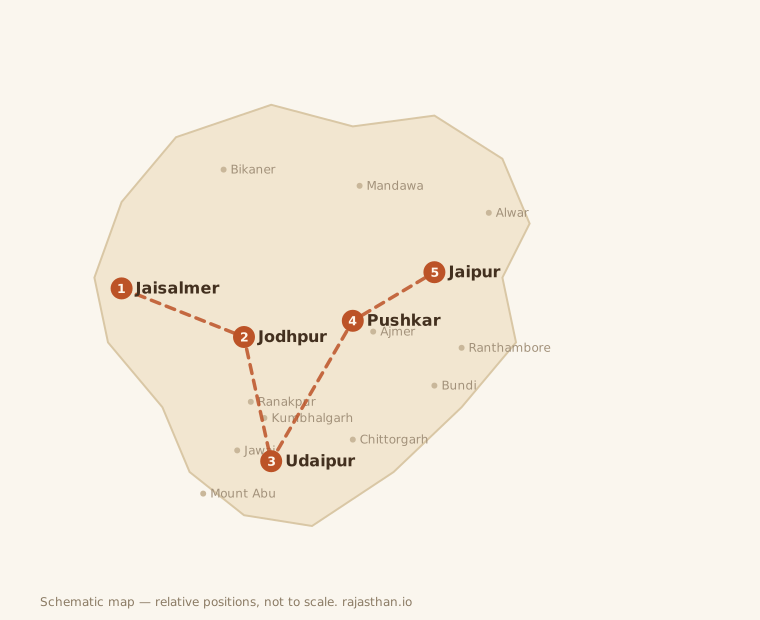
Udaipur closes the classic circuit — see the 3-day Udaipur itinerary for the full plan, or the 10-day Rajasthan route to see where it fits in the grand tour. Coming from Jodhpur, break the 4.5–5 hour drive at Ranakpur and arrive in Udaipur for sunset; leaving southward, Mount Abu or the Gujarat border are the natural next moves. Most people end their Rajasthan trip here, and that is the correct instinct — nowhere else in the state is as good at doing nothing.