Jaipur Travel Guide: Pink City Without the Rush
Jaipur is where most Rajasthan trips begin, and it sets the tone: monumental forts, a living old city painted terracotta-pink, and bazaars that have sold gems and block-print for three centuries. It’s also where trips first go wrong — by cramming five monuments into a day and remembering none of them. Two unhurried days beat one frantic one, every time.
The reason hurry fails is structural. Jaipur’s sights are not clustered: the biggest is eleven kilometres outside the walls, and the two hours you lose to traffic are the two hours you needed for the bazaars.
Understanding the city first
Most Indian old towns grew. Jaipur was designed — founded in 1727 by Sawai Jai Singh II, an astronomer-ruler who moved his capital down from the hills at Amber and had it laid out by the scholar Vidyadhar Bhattacharya on a grid of nine rectangular blocks. That plan earned the walled city UNESCO listing in 2019, and makes it unusually easy to walk: the axes are broad, the cross-streets regular, each bazaar in its own block. The pink came later — painted on in 1876 for a royal visit, now maintained by ordinance, which is why the shopfronts match even when the buildings don’t.
The essential five
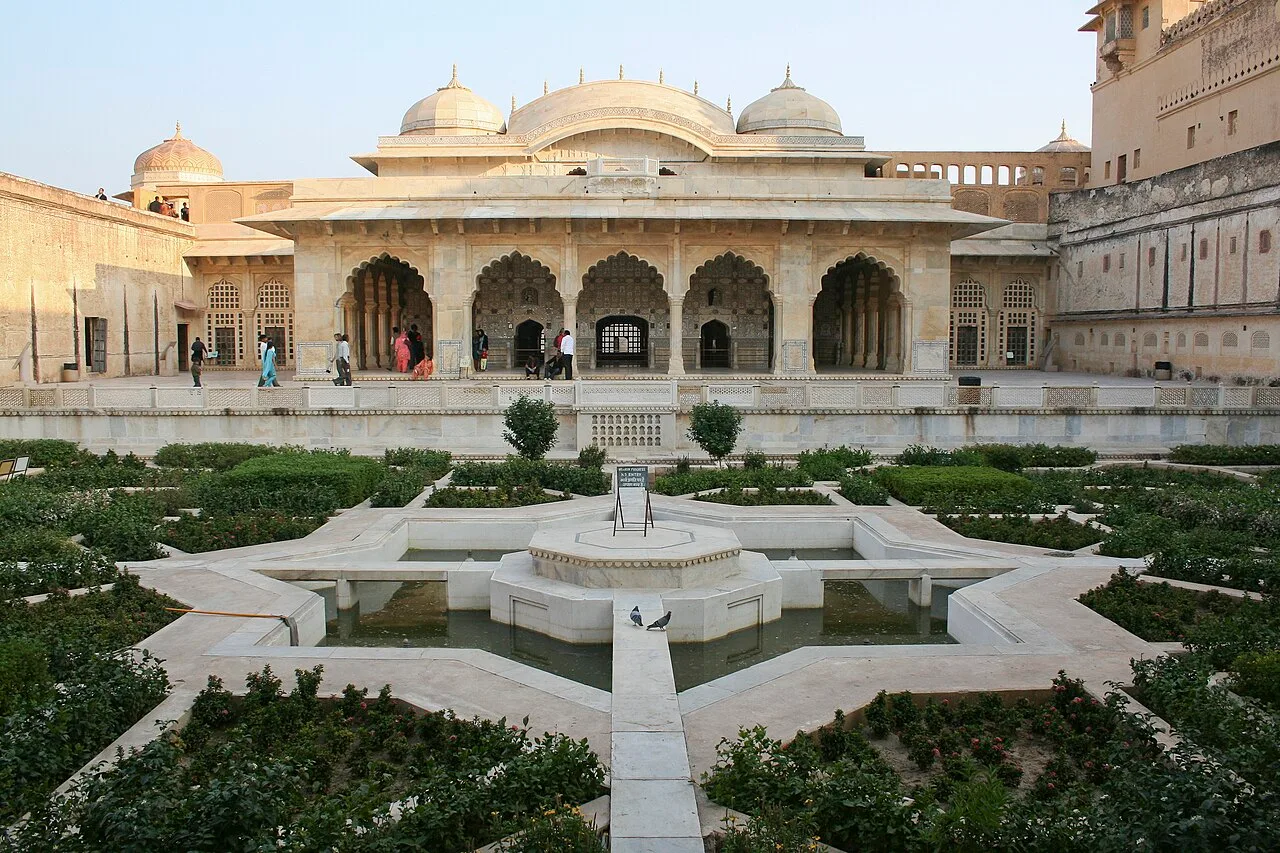
Amber Fort (Amer). The one unmissable sight, 11 km north of the city — a hill fortress-palace of ramparts, mirrored halls and courtyards above Maota Lake, begun by Raja Man Singh I in the 1590s. Go early morning: you’ll beat both the heat and the tour buses, and the light on the honey-colored walls is at its best. Allow a half day with the climb (or the shuttle jeeps).
Walk it deliberately. You enter the courtyard of Jaleb Chowk, climb to the pillared audience hall, then pass the Ganesh Pol — the painted gate dividing public fort from private palace, and the best surface decoration in Jaipur. Beyond it, Sheesh Mahal is the interior everyone comes for: convex glass set into plaster so lamplight multiplies. Opposite sits Sukh Niwas, cooled by water running in channels cut through the floor — desert air-conditioning, four hundred years old. Skip the elephant ride up (walking or a jeep is kinder and faster) and skip Jaigarh Fort above unless forts are your particular interest; it will eat the rest of your morning. Our Amber Fort guide covers the layout gate by gate.
City Palace. Still home to Jaipur’s former royal family, in the old city and five minutes’ walk from Jantar Mantar. The courtyards, the four seasonal Ridhi-Sidhi gates and the armoury reward a slow ninety minutes. Start at Mubarak Mahal and its costume collection, then the Diwan-i-Khas, where two vast sterling silver urns stand — made to carry Ganges water to England so a maharaja could make the voyage without drinking anything else. The painted gates of Pritam Niwas Chowk each represent a season; the peacock gate draws the queue and the other three are usually empty. The premium “royal quarters” ticket is expensive — worthwhile for architecture lovers, skippable for most.
Hawa Mahal. The five-storey pink honeycomb façade is Jaipur’s postcard, built in 1799 so royal women could watch street processions unseen through hundreds of small screened windows. Two practical notes: the famous view is from the street or the cafés opposite (go before the shutters open for a clean shot), and the interior is quick but fun for the breeze-catching windows that gave it its name. One thing catches people out — the entrance is not on the famous façade; you go in from the courtyard behind. Thirty to forty minutes inside; the Hawa Mahal guide has the photo angles.
Jantar Mantar. A UNESCO-listed observatory of giant stone instruments, including the world’s largest stone sundial — accurate to about two seconds. These are not models: Jai Singh II built them as working instruments to correct the astronomical tables of his day. Ninety minutes with a guide, twenty without, which tells you how to do it — unexplained, it’s abstract sculpture.
The bazaars. Johari Bazaar for jewellery, Bapu Bazaar for textiles and mojari slippers, Sireh Deori for the Hawa Mahal frontage, Tripolia for lac bangles and brassware, Chandpole for marble carving. Evening is the hour — the pink façades glow and the streets fill. Bargain expected, smiles included.
Worth adding if you have the time
- Nahargarh Fort at sunset — the city view is the point, but Madhavendra Bhawan’s nine identical interlinked suites, one per queen, are stranger and better than the view.
- Panna Meena ka Kund, the stepwell near Amber — five minutes, no ticket, best combined with the fort morning.
- Jal Mahal, floating in Man Sagar Lake — a photo stop on the Amber road, not a visit (entry isn’t open to the public).
- Patrika Gate — the rainbow-painted gate that took over Instagram; go early if you want it empty.
- Anokhi Museum of Hand Printing, in a restored haveli near Amber — the clearest explanation of block-printing you’ll get before you buy any.
How many days, and in what order
Two full days covers the essential five plus one or two extras at a humane pace. This is the order that wastes the least time.
| Day 1 | |
|---|---|
| 07:30 | Leave for Amber — be at the gate for opening |
| 08:00–11:00 | Amber Fort, unhurried, ending on the terraces |
| 11:00–11:30 | Panna Meena ka Kund, then the Jal Mahal photo stop |
| Midday | Back to the hotel; eat and sit out the worst heat |
| 16:00 | Nahargarh Fort for the late light |
| 19:00 | Old city bazaars on foot, dinner in Johari Bazaar |
| Day 2 | |
|---|---|
| 09:00 | City Palace, ahead of the coach groups |
| 11:00 | Jantar Mantar next door, with a guide |
| 12:30 | Hawa Mahal — façade from across the street, then inside |
| Afternoon | Albert Hall Museum, block-print workshops, or shopping |
| Evening | Rooftop dinner over the old city |
Our 2-day Jaipur itinerary times this hour by hour. With a third day don’t add monuments — the 3-day version spends it on the block-print villages, Galtaji and an unhurried bazaar afternoon. One day is possible but lopsided: Amber early, City Palace and Jantar Mantar after the heat, Hawa Mahal from the street. You’ll see Jaipur; you won’t feel it.
Where to stay
The sweet spot for most travellers is the C-Scheme / MI Road area — walkable to the old city, full of restaurants, quieter at night, easiest for a cab at any hour. Heritage lovers should look at the converted havelis around Bani Park, a leafy pocket ten minutes from the station where family-run heritage guesthouses are the speciality.
Staying inside the walled city is atmospheric but noisy; horns start early and the bazaars don’t wind down until late. Staying near the station is convenient for nothing except the station. The Amber road has grand hotels with fort views that leave you twenty-five minutes from dinner in every direction — a splurge choice, not a two-day-trip choice.
Getting there and around
Jaipur has a well-connected airport (domestic hubs plus some international) 13 km south of the centre, and fast trains from Delhi (~4.5 hours on the better services; the highway drive is about 5). In town, use app cabs or negotiate auto-rickshaws by the half-day; the metro is limited but handy for the old city stretch. A car and driver for the day is the right call for Amber plus Nahargarh — the fort road, stepwell and lake palace are strung along a route no rickshaw handles well.
| Onward from Jaipur | Road time |
|---|---|
| Pushkar | ~3 hours |
| Ranthambore (Sawai Madhopur) | ~3.5 hours |
| Bundi | ~4 hours |
| Agra | ~4.5 hours |
| Jodhpur | ~5.5 hours |
What Jaipur tastes like
The signature is the pyaaz kachori — a fist-sized fried pastry stuffed with spiced onion, eaten hot, standing up, at a sweet-shop counter. The institutions that do it sit around Johari Bazaar and near Sindhi Camp, and they have breakfast queues for a reason.
Beyond that: dal baati churma, baked wheat balls drowned in ghee; laal maas, the fiery red mutton curry of Rajput hunting camps; and ghewar, a lattice-fried disc soaked in syrup that appears around the monsoon festival of Teej and is genuinely seasonal. Finish with a thick set lassi in a clay cup from an MI Road stall. For shopping with substance, the block-printing villages of Sanganer and Bagru half an hour out are where the bazaar’s textiles are actually made; a workshop visit takes two hours and changes what you’re willing to pay for a hand-printed quilt.
Mistakes to skip
- Doing Amber at midday. The fort is a sun-trap; mornings are cooler, emptier, better lit.
- Buying gems as “investments.” Jaipur’s gem trade is real, and so are its tourist-pricing games. Buy what you love at a price you’d pay for the pleasure of it — nothing more.
- Treating Jaipur as a half-day stop between Delhi and elsewhere. The city punishes hurry with traffic and rewards patience with detail.
- Accepting the driver’s shopping stops. A “government emporium” inserted into your day is a commission arrangement, not a recommendation. Say no clearly when you agree the plan.
- Underestimating the Amber run. Eleven kilometres reads as nothing and takes forty minutes each way once traffic builds.
Questions people actually ask
Is one day enough? Enough for Amber and the City Palace, not enough for the bazaars at a pace worth having. If one day is all you have, take Amber in the morning and the old city in the evening, and let Jantar Mantar go.
Can I visit the Taj Mahal from Jaipur? Yes, but as a transfer rather than a day trip — Agra is about four and a half hours each way. Note that the Taj Mahal closes on Fridays, which quietly ruins more itineraries than any other fact in north India. The Jaipur to Agra guide has the route and the Fatehpur Sikri stop.
Do I need a guide? At Jantar Mantar, yes — it’s unreadable without one. At Amber a good guide adds a lot and a bad one recites dates; agree price and duration first. At the City Palace and Hawa Mahal you can manage alone.
Is it safe to walk in the evening? The main bazaar streets are busy, lit and fine well into the night. Ordinary city sense applies — keep valuables close in crowds, use an app cab rather than an unmetered auto late on.
How Jaipur fits a wider route
Jaipur is the natural entry to Rajasthan and the eastern corner of the Delhi–Agra–Jaipur triangle, which is why nearly every route through the state starts here.
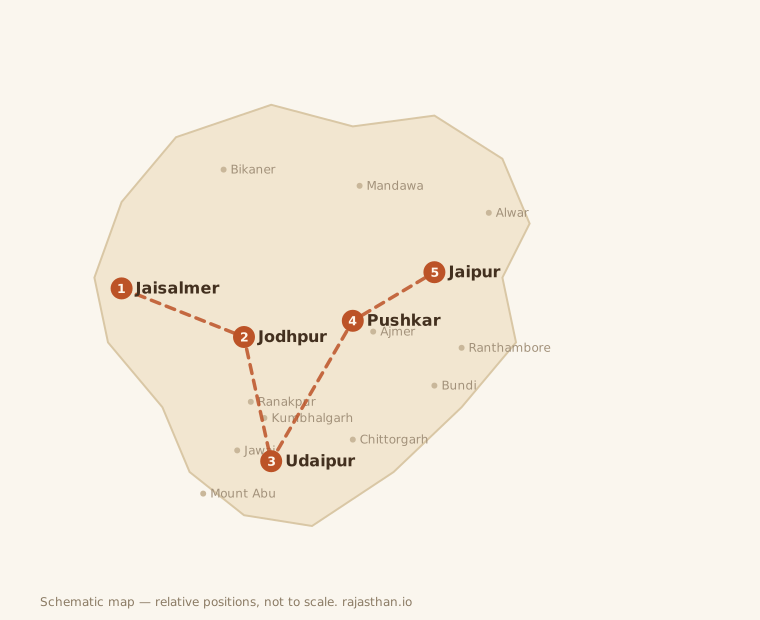
From Jaipur the state opens westward: Jaipur → Pushkar (three hours, an easy half-day addition) → Jodhpur → the desert. Travellers with a week usually take Jaipur, Jodhpur and Udaipur with one desert or wildlife night between — the 7-day Rajasthan circuit sets out where the long drives fall.
Two days here is the right budget in almost every version of that route. The temptation is to take a night off Jaipur to add a city further west; resist it. This is the one place where fort, palace, observatory and market sit in the same town, and it is the best introduction to everything that follows.