Jaipur in 2 Days: An Hour-by-Hour Itinerary
Two days is Jaipur’s natural rhythm: one day for the Amber side of the city, one for the walled old town. This plan sequences everything around the three forces that actually govern a Jaipur day — morning light, midday heat, and evening traffic.
Get that order wrong and Jaipur punishes you very specifically. Amber Fort at eleven in the morning is a car park with a fort attached. The old city at two in the afternoon is a heat trap with no shade and no patience. The ridge road to Nahargarh on a Saturday evening can swallow an hour you did not budget. Get it right — early on the north side, horizontal at midday, out again for the last two hours of light — and two days feels unhurried.
The shape of the trip
| Day | Where | Sleep in |
|---|---|---|
| 1 | Amber Fort, Panna Meena, Jal Mahal, Nahargarh sunset, Bapu Bazaar | Jaipur |
| 2 | Hawa Mahal, City Palace, Jantar Mantar, Patrika Gate, Johari Bazaar | Jaipur |
One hotel, two nights, nothing to pack in between. That is the quiet luxury of a city trip and you should exploit it: book somewhere with a pool or a decent shaded terrace, because both afternoons are spent there by design.
Day 1 — Amber and the north
7:00–8:00 · Drive to Amber Fort. Leave early; the 11 km road roughly doubles in time after 9. You want to be walking up as the gates open, not queueing behind the first coaches. Take a car or an app cab — an auto-rickshaw will do it, but it is a long, dusty, uphill ride.
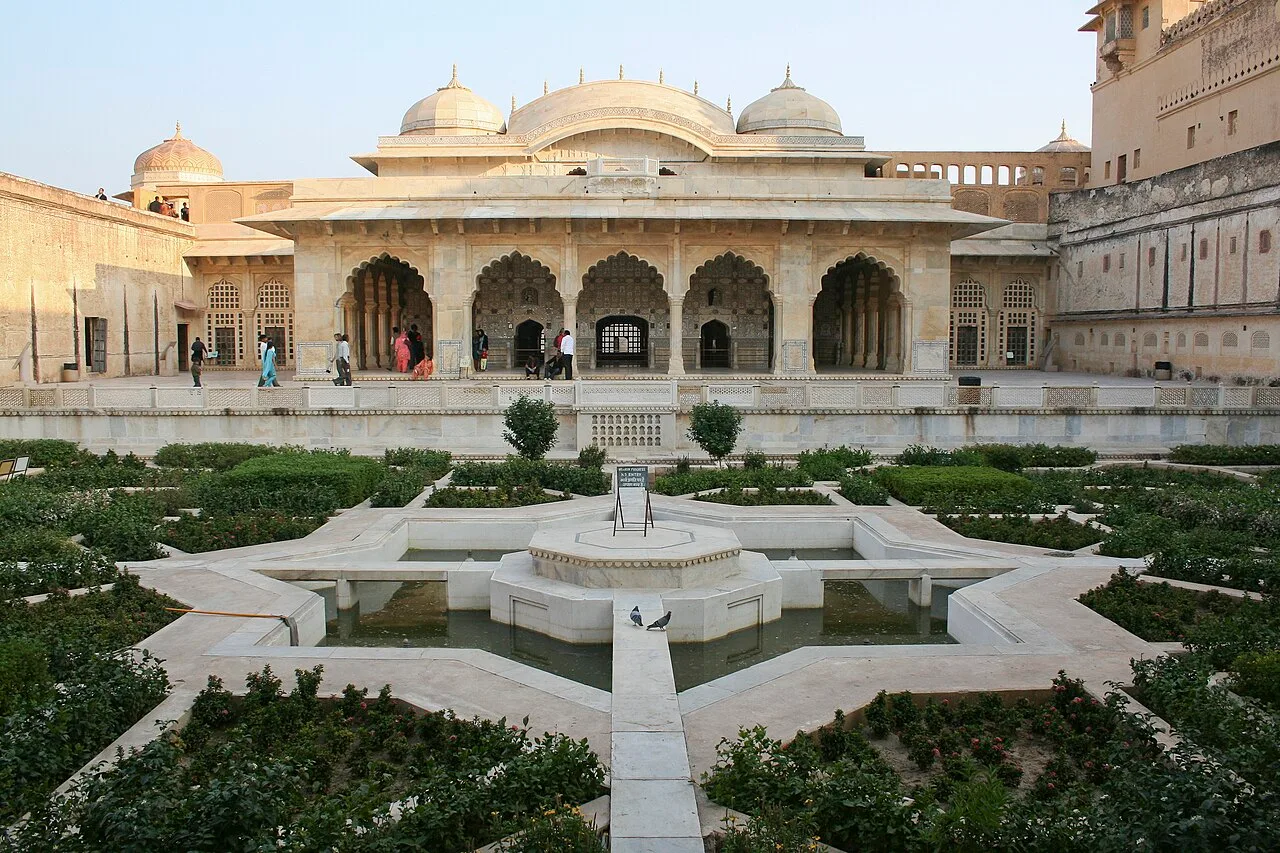
8:00–11:00 · Amber Fort. Three unhurried hours, and it needs all of them. Come in through Suraj Pol into Jaleb Chowk, the vast parade courtyard, while it is still quiet. Climb to the Ganesh Pol — the painted gateway that is the fort’s finest single piece of surface — and then into the Sheesh Mahal, the mirrored hall, before the groups arrive; it is a small room and twenty people ruin it. Finish on the ramparts above Maota Lake, looking down on the Kesar Kyari garden floating in the water, and take the passage across to the older Man Singh palace block behind. Walk up from the car park or take a jeep — skip the elephants.
11:00–11:30 · Panna Meena ka Kund. The criss-cross stepwell five minutes from the fort gate: eight storeys of symmetrical staircases running down all four walls. Quick, and exactly what your camera hoped Rajasthan looked like. You cannot walk on the steps any more; the view from the rim is the point.
11:30–12:15 · Jal Mahal photo stop. On the drive back, the water palace floats in Man Sagar Lake. It is a roadside stop, not a visit — there is no interior access and no boat. Ten minutes on the embankment, then onward to lunch and the day’s smartest move.
13:00–16:00 · Lunch and rest. Jaipur afternoons are for shade. Eat well — a lassi at one of the old MI Road institutions counts as sightseeing — then nap, swim, or sit somewhere with a fan. Travellers who skip this step are the ones who arrive at Nahargarh too flattened to enjoy it.
16:00–18:00 · Nahargarh Fort for sunset. Up the ridge road with time to spare. Give the fort itself twenty minutes — Madhavendra Bhawan inside is nine near-identical queens’ suites linked by corridors arranged so the maharaja could visit one without the others knowing, and walking it is genuinely odd — then take the ramparts as the light goes. The whole pink grid lies below you turning gold, then dusk-blue, with Jal Mahal a bright rectangle to the north.
18:30–20:30 · Bapu Bazaar. Come down into the evening city. Bapu is the textile and slipper bazaar: block-print cotton, mojari, quilts, and the walled city lit up behind its arcades. Prices start high for foreigners and everyone knows it; treat the negotiation as the entertainment it is.
Day 2 — The walled city
7:30–8:00 · Hawa Mahal from the street. The honeycomb façade faces east, so morning is the only time it is properly lit — and the pavement opposite is empty at half past seven. Five storeys of latticed windows built so the women of the court could watch the street unseen. The interior visit is a separate thing entirely (enter from the rear, 30–40 minutes) and is optional; the building is a façade in the literal sense, barely a room deep.
9:00–11:00 · City Palace. Two hours. The royal courtyards, the enormous silver urns in Sarvato Bhadra, the textile and armoury galleries, and the four Ridhi Sidhi seasonal gates in Pritam Niwas Chowk — the peacock gate is the one you have seen online, and it is on the wall to your right as you enter. Parts of the complex are still the royal family’s private residence, which is why some doors stay shut.
11:00–12:30 · Jantar Mantar. Next door, so you do not lose a minute to traffic. Nineteen astronomical instruments built in stone in the 1730s, including the world’s largest stone sundial. Hire the guide or take the audio tour — this is not optional. Without explanation it is a park full of strange ramps; with it, it is one of the most interesting places in India.
12:30–14:30 · Lunch and the craft lanes. A traditional thali near the palace, then wander: block-print workshops, blue pottery, lac bangles, and the narrow lanes between Chhoti Chaupar and Badi Chaupar where the city still makes things rather than selling them.
15:00–16:30 · Patrika Gate or Albert Hall. Choose your closer. Patrika Gate at Jawahar Circle is a modern painted gateway — arch after arch of pattern in every colour Jaipur owns, built to be photographed and unashamed about it. Albert Hall is the state’s oldest museum in a full-throated Indo-Saracenic building, with miniatures, textiles, armour and an Egyptian mummy. Photographers take the gate; history readers take the museum, which is also handsome after dark when it is floodlit and reflected in its pool.
17:00–19:00 · Johari Bazaar finale. The jewellery bazaar at golden hour — gemstones, kundan and meenakari work — with a stop for kachori and sweets at a shop older than most countries’ constitutions. Finish here and walk back through the gates in the dark.
Where to sleep
Two nights in one bed, and the neighbourhood matters more than the hotel.
- C-Scheme / MI Road is the default and the right answer for most people: a short ride from the old city, the best concentration of restaurants, and quiet enough to sleep. Both of this plan’s evening returns are easy from here.
- Bani Park is where the converted heritage havelis are — courtyards, pools, a bit more character, a bit further out.
- Inside the walled city is atmospheric and loud. If you want to walk out of your door into Day 2, take it; if you are a light sleeper, do not.
- Near the railway station is convenient for the railway station.
What to cut, what to add
Only a day and a half? Run Day 1 as written and cut Day 2 down to Hawa Mahal at dawn plus Jantar Mantar with a guide. Drop City Palace before you drop the observatory — it is the more unusual of the two.
One full day only? Do not attempt both halves. Take Amber in the morning, rest, and finish with Nahargarh and the bazaars. The walled-city monuments survive being skipped; the Amber morning does not compress.
A spare third day? It buys you the hill forts properly — Jaigarh with its enormous Jaivana cannon, Galtaji’s temple gorge at dawn, and an evening that is about eating rather than walking. The 3-day Jaipur plan reshuffles all of the above to make room, moving Panna Meena and Albert Hall off Days 1 and 2.
Common mistakes
- Starting Amber at nine. The single most expensive error in Jaipur. You lose the light, the quiet and about forty minutes of road time.
- Sightseeing straight through the afternoon. The 1–4 pm block is not usable for outdoor monuments for most of the year. Plan the rest in, or the heat will plan it for you.
- Doing Amber and Nahargarh on different days. They are both on the northern ridge. Pairing them keeps Day 2 entirely inside the walled city, which is walkable.
- Buying single tickets without checking the composite. Jaipur sells a composite ticket covering Amber, Nahargarh, Jantar Mantar, Albert Hall and several other sites, valid across two days. On this exact plan it usually pays for itself — check what is included before you buy at the first gate.
- Booking a 5 pm arrival flight on Day 0 and calling it a two-day trip. It is not. Land by midday or accept that you have a day and a half.
Seasonal notes
October to March is the season, and December–January mornings are cold enough for a jacket at Amber before the sun clears the ridge. From April, shift every start time an hour earlier, surrender the 1–4 pm block entirely, and treat Nahargarh as a 5:30 pm proposition rather than a 4 pm one. May and June routinely pass 40 °C — the fort courtyards are unshaded stone and they radiate. In July–September the monsoon makes the Amber hills briefly green and the light beautiful between showers; nothing on this plan is rain-critical except the Nahargarh view. The best time to visit guide has the month-by-month detail.
Questions people actually ask
Is the Amber Fort light-and-sound show worth staying for? Only if you are not doing Nahargarh at sunset, because the timings collide. Of the two, the Nahargarh evening is the better use of the hour.
Can I do this without hiring a car? Day 2 yes — app cabs and autos handle the walled city easily. Day 1 no, or at least not comfortably: hire a car for the half-day Amber loop so that Panna Meena and Jal Mahal come free on the way back.
Should I visit Hawa Mahal’s interior? Optional. It is 30–40 minutes of ramps and small chambers with a good view back down the street from the top. If your two days are tight, the façade at 7:30 is the sight; the inside is a bonus.
Is two days enough for a first trip to Rajasthan? For Jaipur, yes. For Rajasthan, no — Jaipur is the opening act, and the road west is where the trip actually happens.
Where this fits
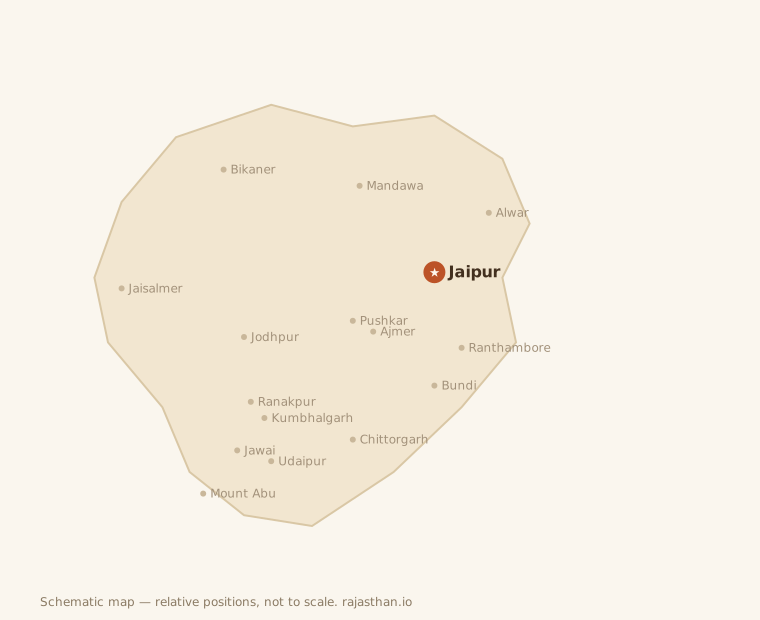
Pushkar’s holy lake is under three hours west, and Day 3 writes itself from there. Coming from Delhi, the train is roughly 4.5 hours on the better services.
- Full city detail — food, shopping, neighbourhoods — in the Jaipur guide
- Amber Fort guide for the fort in depth
- Hawa Mahal guide for the façade and the interior question
- Jaipur in 3 days if you have the extra day
- Rajasthan in 5 days — Jaipur, Pushkar, Udaipur
- Rajasthan in 7 days — the classic circuit with Jodhpur added
- Jaipur to Agra and the Taj Mahal if you are heading east afterwards (note the Taj is closed on Fridays)
- Pushkar — the obvious next stop