Jodhpur Travel Guide: Mehrangarh and the Blue City
If you only climb one fort in Rajasthan, make it Mehrangarh. Rudyard Kipling called it the work of giants, and from the old city 120 metres below it’s hard to argue — sheer walls growing straight out of the rock, with the indigo-washed lanes of the Blue City pooled at its feet. Jodhpur is compact: one intense day covers it, two lets it breathe.
It is also the least ornamental of Rajasthan’s big four — a hard-edged trading city of well over a million people that grew up under a fort built for war and never stopped being practical about it. Nothing here has been softened for visitors, and the city is better for it.
Mehrangarh: the best-run fort in the state
Mehrangarh isn’t just the most dramatic fort in Rajasthan — it’s the best curated, run by a trust that takes museums seriously. The palace interiors (Phool Mahal, the palanquin and howdah galleries, the cradle room) are genuinely worth the audio guide, which is included with entry and excellent.
The approach and the gates
Rao Jodha began the fort in 1459 when he moved the Rathore capital from Mandore to this rock, and the family has held it ever since. The road curls up through a sequence of gates, each one a piece of evidence.
- Jai Pol — the victory gate, added in the early nineteenth century after Maharaja Man Singh saw off armies from Jaipur and Bikaner. The pockmarks on the walls nearby are cannonball scars from that siege, and they are not subtle once you know to look.
- Loha Pol — the iron gate, turned at a sharp angle so war elephants couldn’t build up a charge. Beside it are small handprints left by royal widows who went to sati on Maharaja Man Singh’s pyre in 1843. Pilgrims still leave offerings here. It is a memorial, not a photo stop; treat it as one.
Walk down through the gates at the end of your visit rather than up at the start — the gradient is friendlier and the light is better.
Inside the palace
The museum occupies the palace courtyards, and the sequence is the point: Moti Mahal, where the ruler held court under a ceiling of mirrorwork; Phool Mahal, the gold-leafed pleasure room; Takhat Vilas, a private chamber with painted walls and, bizarrely, imported glass baubles on the ceiling; and the Zenana Deodi, where hundreds of carved jali screens let the women of the household watch court proceedings unseen. The collections — palanquins, elephant howdahs, Marwar-school miniatures, turbans, an arms gallery with the real weapons rather than replicas — are labelled properly.
Allow two and a half to three hours for the fort alone. If you are short on time, the courtyards and the howdah gallery are the parts to keep; the textile displays are the parts to walk briskly through. Our Mehrangarh Fort guide breaks the visit down room by room.
Go early or late — the fort faces the day’s heat with stone honesty. Two extras worth the add-on: the zip-line circuit over the ramparts and desert rock (surprisingly good, and the views are the point), and Chokelao Bagh, the restored eighteenth-century terraced garden on the fort’s flank, which almost nobody bothers with and which is the quietest place in Jodhpur at sunset.
Jaswant Thada and the rock park
Below the fort, white-marbled Jaswant Thada — the royal cenotaphs, built in 1899 for Maharaja Jaswant Singh II — is a peaceful twenty minutes with the best fort-profile photo in town. The marble is quarried thin enough that it glows amber when the sun is low.
Next door, the Rao Jodha Desert Rock Park is volcanic rock replanted with native Thar species after decades of invasive scrub — marked trails, real silence, the fort walls overhead. An hour if you like walking; skip it if you don’t.
The Blue City
The indigo lanes of Navchokiya / Chandpol are the Jodhpur of photographs. Why blue? Pick your theory — Brahmin tradition, insect-repelling lime, heat reflection — locals cite all three. The truth of walking it: get lost deliberately, morning light, accept the tea invitations, and ask before photographing doorsteps that are, after all, homes.
Two practical notes. The blue is patchy, not total — it concentrates in the Navchokiya and Brahmpuri quarters on the fort’s north and west sides, and the view from the fort ramparts will tell you exactly where to aim. And the lanes are genuinely maze-like, on a slope, with motorbikes. Wear shoes you can walk in and give it a full two hours rather than twenty minutes.
Toorji ka Jhalra and the new old town
The 18th-century stepwell at Toorji ka Jhalra has become the anchor of Jodhpur’s most pleasant quarter — restored geometry of red sandstone steps, ringed by cafés and boutique stays. Come at golden hour, drink something cold, and watch local kids turn the monument into a diving pool.
It was commissioned by a queen consort of Maharaja Abhaya Singh, silted up for generations, and only fully excavated in the last decade — which is why the surrounding block feels newer and better-swept than anywhere else in the old city. This is the one part of Jodhpur tidied for visitors, and it is honestly done.
Sardar Market and the clock tower
Jodhpur’s commercial heart since the 1880s: spice pyramids, bangle lanes, saree stalls, and the famous makhaniya lassi thick enough to require a spoon. It’s a market that still mostly serves locals — the best kind. Evening is peak theatre.
Prices here are quoted for tourists and then negotiated; that’s normal and not personal. What’s actually worth buying: spices (this is a serious wholesale hub — buy whole, not ground), bandhej tie-dye textiles, and, if you have shipping sorted, furniture from the export workshops out towards Sardarpura. The riding breeches called jodhpurs really did originate here.
What to eat
Jodhpur’s street food is the best in western Rajasthan and aggressively unrefined.
| Dish | What it is | When |
|---|---|---|
| Mirchi bada | A whole mild chilli, stuffed with spiced potato, battered and fried | Late afternoon, hot from the pan |
| Pyaaz kachori | Onion-filled fried pastry, crushed and topped with chutney | Breakfast |
| Mawa kachori | The sweet version — thickened milk, sugar syrup | After dinner, share one |
| Makhaniya lassi | Saffron-and-butter lassi, near-solid | Midday, near the clock tower |
Order a full Marwari thali at least once: dal baati churma, gatte ki sabzi, ker sangri made from desert beans and berries. See the Rajasthan food guide for what each of those actually tastes like.
Umaid Bhawan
The last great palace built in India (finished 1943, Art Deco throughout) is part royal residence, part luxury hotel, part small museum. The museum wing is a quick visit and mainly for architecture and classic-car fans — go if the sandstone dome has been staring at you all day and you need to know.
Worth knowing before you decide: it was commissioned as famine relief, employing thousands over more than a decade, and the golden sandstone blocks are interlocked dry, without mortar. That backstory is more interesting than the museum, which is a modest run of clocks, glassware and vintage cars. Forty-five minutes is plenty, and non-residents cannot enter the hotel wing — don’t come out here expecting a palace tour.
A day in Jodhpur, hour by hour
If you have exactly one day, this order works and avoids the worst of the heat and the crowds:
- 08:00 — Up to Mehrangarh as it opens. Audio guide, courtyards, museum.
- 10:45 — Walk down through Loha Pol and Jai Pol to Jaswant Thada.
- 11:30 — Taxi or short walk to the Blue City edge at Navchokiya; wander down through the lanes towards the old town.
- 13:30 — Lunch and a makhaniya lassi near the clock tower.
- 15:00 — Rest. Not optional even between October and March; the afternoon sun is flat and hard.
- 17:00 — Toorji ka Jhalra, coffee on the steps.
- 18:15 — Sardar Market at full evening noise.
- 20:00 — Rooftop dinner facing the floodlit fort. Book a table with a view; the good ones fill.
With a second day, insert Umaid Bhawan and Mandore Gardens — the pre-1459 Rathore capital, nine kilometres north, where the royal cenotaphs were built as full temples rather than domes. Green, shady, mostly local families, and a good antidote if forts have started to blur. Further out, Osian (about 65 km north) has eighth- to twelfth-century Jain and Hindu temples with real carving and almost no crowds, and Jawai, roughly three hours south, is the leopard-country stop — better as an overnight towards Udaipur than a day trip.
One caution: Bishnoi village safaris are sold hard by every hotel. The Bishnoi community’s five-century record of protecting blackbuck and khejri trees is real and remarkable; many of the tours are a shopping circuit with a wildlife pretext. Ask exactly where you are going before booking, and decline anything billed as an “opium ceremony”.
How many days?
One full day covers fort + Jaswant Thada + stepwell + market. A second day adds the Blue City walk at the right pace, Umaid Bhawan, and an unhurried evening — worth it if your route allows. Jodhpur’s real role in most trips is the hinge between Jaisalmer and Udaipur: see the 7-day and 10-day routes.
Where to stay
Sleep in the old city if atmosphere matters: guesthouse rooftops under the floodlit fort are Jodhpur’s signature evening. The Toorji ka Jhalra quarter balances character with comfort best; heritage havelis around Fort Road run from budget to boutique.
By neighbourhood:
- Old city / Brahmpuri (under the fort). Maximum atmosphere, minimum comfort — steep lanes, no car access to many doors, temple bells at dawn. Right if you want to walk everywhere.
- Toorji ka Jhalra. The sweet spot: restored havelis and small design hotels around the stepwell, cafés at street level, five minutes from the market.
- Sardarpura / Ratanada. Modern hotels and wide roads. Comfortable, characterless, useful if you are driving in and out with luggage.
Getting there and around
Well-connected airport (Delhi, Mumbai) and solid rail links — including the 5–6 hour line to Jaisalmer and overnight options to Delhi. By road: Jaipur ~6 hours, Udaipur 4.5–5 via the worthwhile Ranakpur detour, Jaisalmer ~5.
Jodhpur Junction sits in the middle of town, ten minutes from the clock tower, which makes the train genuinely convenient here in a way it isn’t everywhere in Rajasthan. The airport is a civil enclave on an Air Force base — small, occasionally restricted, and not a place to take photographs.
Within the city, auto-rickshaws are the default; agree the fare first. Almost nothing in the old city is drivable, so plan to walk between the market, the stepwell and the Blue City lanes. For a fort-to-Jaswant-Thada-to-Blue-City morning, a half-day car with driver removes three hot uphill walks and is the best money you’ll spend here. More on options in the getting around Rajasthan guide.
How Jodhpur fits your route
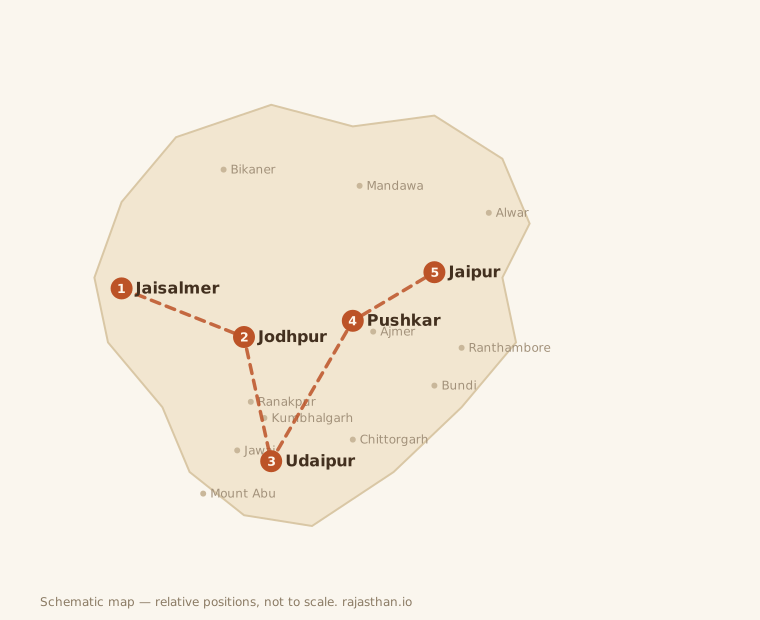
Jodhpur is the junction of western Rajasthan. Almost every sensible route through the state passes through it, and it works in both directions:
- Westward to the desert. Jodhpur → Jaisalmer is about five hours by road or 5–6 by train — the train is the better option, and the Jodhpur–Jaisalmer itinerary sets out how to split the time. Note that Thar nights drop close to freezing in December and January; pack a real jacket if you are camping out there.
- Southward to the lakes. Jodhpur → Udaipur is 4.5–5 hours with the Ranakpur Jain temple detour, which is the right way to do it. Two constraints matter: Ranakpur admits general visitors only after midday, so leave Jodhpur late morning rather than at dawn, and leather items are refused at Jain temples — belts, bags, camera straps. Leave them in the car.
- Eastward to the capital. Jaipur is around six hours, which is a full driving day with nothing worth stopping for in the middle. The train is more comfortable.
Common mistakes
- Arriving at Mehrangarh at midday. The courtyards are unshaded and the crowds peak. Opening time or late afternoon, always.
- Leaving early for the Ranakpur detour. You’ll arrive before the temple admits tourists and sit outside. Depart after breakfast at the earliest.
- Giving Jodhpur half a day between two long drives. The fort alone needs three hours. A stopover Jodhpur is a wasted Jodhpur.
- Treating the Blue City as a photo set. Those are front doors. Ask, and accept no.
- Under-packing for winter nights. December and January days are warm; a rooftop dinner at nine is not.
Questions people actually ask
Is one day in Jodhpur enough? Yes, if it’s a full day and you start at the fort by eight. You’ll cover Mehrangarh, Jaswant Thada, the stepwell and the market. What you’ll lose is the Blue City at walking pace, which is the part people remember.
Is Jodhpur better than Jaisalmer? Different jobs. Jodhpur has the greater fort and a real city around it; Jaisalmer has the desert and a living fort you can sleep inside. On a seven-day trip most people should do both — they are five hours apart and the contrast is the reward.
When should I come? October to March, with November to February the sweet spot. April onwards gets punishing, and by May sightseeing effectively ends before noon. The best time to visit Rajasthan guide has the month-by-month detail.
Can I do Jodhpur as a day trip from Udaipur or Jaipur? No. Both are five to six hours each way. Jodhpur needs a night, and it earns two.