Pushkar Travel Guide: Lake, Temple & Camel Fair
Pushkar is two towns sharing one small lake. The first is among Hinduism’s holiest places — 52 bathing ghats around water said to have sprung where Brahma dropped a lotus, and one of the world’s very few temples dedicated to Brahma himself. The second is a backpacker bazaar of rooftop cafés, falafel, and shopping. The mix is odd and oddly charming — and it’s an easy 2.5–3 hour hop from Jaipur that breaks the drive west perfectly.
Get the order of importance right and Pushkar works. It is a pilgrimage town that acquired a travellers’ scene, not a travellers’ town with a temple in it. Almost everything that frustrates visitors here — the persistence at the ghats, the no-meat-no-alcohol rule, the crowds at certain moons — follows from that one fact.
The lake and the ghats
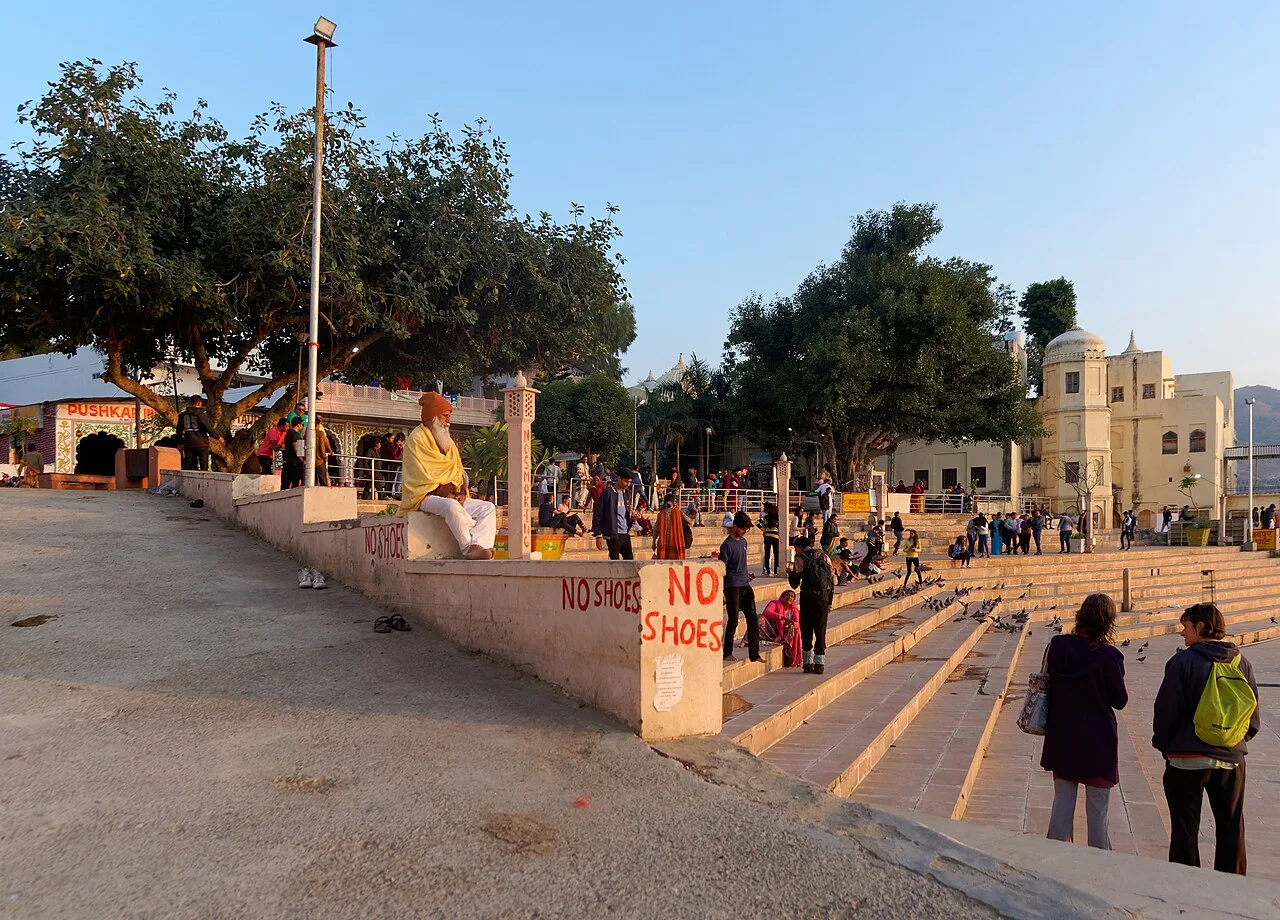
Everything radiates from the water. Walk the ghat circuit at dawn or dusk — bells, pigeons wheeling, pilgrims immersing — and observe the basics: shoes off near the ghats, no photos of bathers, and calm refusal of unsolicited “pushkar passport” flower-priests (if you want a blessing ceremony, agree the donation first; if not, a polite folded-hands namaste and walking on works fine).
The full circuit is a slow forty-five minutes to an hour, and it is the single best thing to do in Pushkar. Each ghat has its own dedication and its own regulars: Brahma Ghat and Varaha Ghat are the busiest for ritual bathing, and Gau Ghat is where the ashes of several national figures, Gandhi among them, were immersed. You will see families performing pind daan for the dead, priests reciting for clients seated on the steps, and a completely ordinary amount of laundry and gossip. All of it is the town working, not a performance.
Two honest notes. First, the water level swings with the monsoon; in a weak year the lake shrinks and the far ghats sit dry, and the town has drained and desilted it before. Second, the flower-priest routine is the only real irritant in Pushkar and it is a firm-but-friendly problem, not a threatening one. Accepting a flower is treated as accepting the ceremony. Decide before your hand moves.
Brahma Temple
Modest in size, immense in rarity — Hindu tradition holds that a curse limits Brahma’s temples, making this red-spired 14th-century shrine the most important of the very few that exist. Queues move fast; mornings are calmest. No phones or cameras inside.
Inside, look for the four-faced image of Brahma with Gayatri seated beside him, the hamsa goose motif that marks the god throughout, and the marble floor of the outer hall studded with silver coins set there by families in memory of their dead. The building is genuinely old; the site is older than the building. It takes twenty minutes, and it will be twenty minutes among worshippers rather than sightseers — dress covered, leave the phone in your bag rather than in your hand, and don’t linger in front of the sanctum.
The viewpoint climbs
Two hilltop temples bracket the lake: Savitri Mata (southwest, the longer climb or a short ropeway ride) and Papmochani (Gayatri) to the northeast. Savitri at sunrise is the classic — the lake, the town, and the desert edge laid out in morning gold. Carry water; the steps mean business.
Practically: Savitri is a stepped climb of roughly forty-five minutes at an unhurried pace, or a few minutes on the ropeway, which runs from the base near the fairground side. Papmochani is a much shorter twenty-minute walk and works better for sunset, because the light comes across the lake towards you. Do one, not both — they show you the same valley from opposite ends.
If you have a spare hour, Rangji Temple in the bazaar is worth a detour for its South Indian gopuram, an entirely unexpected silhouette in a Rajasthani town; the interest is the exterior, and access to the inner shrine is restricted. The Varaha Temple, dedicated to Vishnu’s boar avatar, is the other historically significant one and sees far more pilgrims than visitors.
The bazaar
Pushkar’s main street is one long, likeable shopping crawl: leather bags, silver, mirror-work textiles, secondhand books in eight languages. Prices start optimistic; bargaining is expected and friendly. The café rooftops along the lake’s north side do sunset better than anywhere — note that out of respect for the town’s sanctity, Pushkar is vegetarian and alcohol-free by rule (some menus interpret “special lassi” creatively; know what you’re ordering).
The bazaar is genuinely good value for silver, block-printed cotton and embroidered textiles, and it is one of the few places in Rajasthan where the haggling is done with humour rather than pressure. It is not the place for serious antiques or fine miniatures — Jaipur and Udaipur do those properly. Allow an hour and a half and expect to be back the next morning.
What to eat
The rule is stricter than most visitors expect: no meat, no fish, no alcohol, and many kitchens do not serve eggs either. This is not a soft preference, it is how the town understands itself, and it applies to what you bring in as much as what you order.
What that leaves is better than it sounds. Malpua — a syrup-soaked pancake, best warm from a bazaar counter — is the local sweet worth crossing the street for. Rooftop kitchens do a competent international menu built for long-stay travellers, and the Rajasthani side of the menu (dal baati churma, kadhi, gatte ki sabzi) is honest if unspectacular. Our Rajasthan food guide covers those dishes properly. Drink the kesar lassi; know that a “special” one is not saffron.
The Camel Fair
For one week around Kartik Purnima (November), several hundred thousand people and thousands of horses, camels and cattle turn the desert edge into Rajasthan’s greatest spectacle — trading mornings, race afternoons, ferris-wheel nights. It is genuinely unmissable and genuinely overwhelming: rooms triple in price and sell out months out. Decide early which Pushkar you want — fair-week theatre or off-week serenity. Both are valid; they are different trips.
Two things to understand before you book. The dates move every year, because Kartik Purnima is set by the lunar calendar and can fall anywhere in November (5 November in 2025, 24 November in 2026), so in an early year the fair begins in late October. Check the year you are travelling rather than assuming last year’s window; for 2026, Rajasthan Tourism lists the fair for 17–24 November.
And the fair has two halves that feel nothing alike: the livestock trading dominates the early days out on the fairground, while the religious peak arrives on Kartik Purnima itself, when enormous numbers of pilgrims come to bathe in the lake. If you want the camels and the photography, arrive early in the week. In 2025 the animal fair opened informally on 22 October, eight days before the official programme began. If you want the sacred core of the event, arrive at the end, for the bathing days from Devuthani Ekadashi to the full moon (20–24 November in 2026) — and accept that the ghats will be full and are not yours to photograph freely. The Rajasthan festivals guide sets out how it sits against the rest of the calendar.
Expect fewer camels than the name suggests. Camel arrivals have been falling for years and horses now dominate the fairground: by 29 October 2025, the eve of the official opening, the fair officer put the running count at over 4,000 horses and about 1,400 camels, with more arriving daily.
A day in Pushkar, hour by hour
Pushkar rewards a slow arrival the afternoon before and a proper morning:
- 06:15 — Up Savitri Mata for sunrise, or Papmochani if you’d rather sleep and take the view at dusk instead.
- 08:00 — Breakfast on a rooftop while the town wakes.
- 09:00 — Brahma Temple, before the queue builds and while it is still cool.
- 09:45 — The full ghat circuit at walking pace. Sit somewhere for twenty minutes and just watch.
- 11:30 — Bazaar. Rangji Temple’s gopuram on the way through.
- 13:00 — Lunch, then the flattest part of the day — everything closes in on itself and so should you.
- 16:30 — Second pass at the bazaar for anything you thought about, or the short climb to Papmochani.
- 18:00 — Sunset from a north-side rooftop over the water.
- 19:30 — Evening aarti at the ghats. Stand back, no flash.
How long, and where it fits
One night does Pushkar justice; two suit the unhurried. The standard play is Jaipur → Pushkar (afternoon + evening ghats, next-morning temple and hill climb) → onward to Jodhpur — exactly how our 7-day route uses it. Nearby Ajmer (30–40 minutes) holds the great Sufi shrine of Khwaja Moinuddin Chishti — a worthwhile half-day for those drawn to it, and the region’s main rail junction.
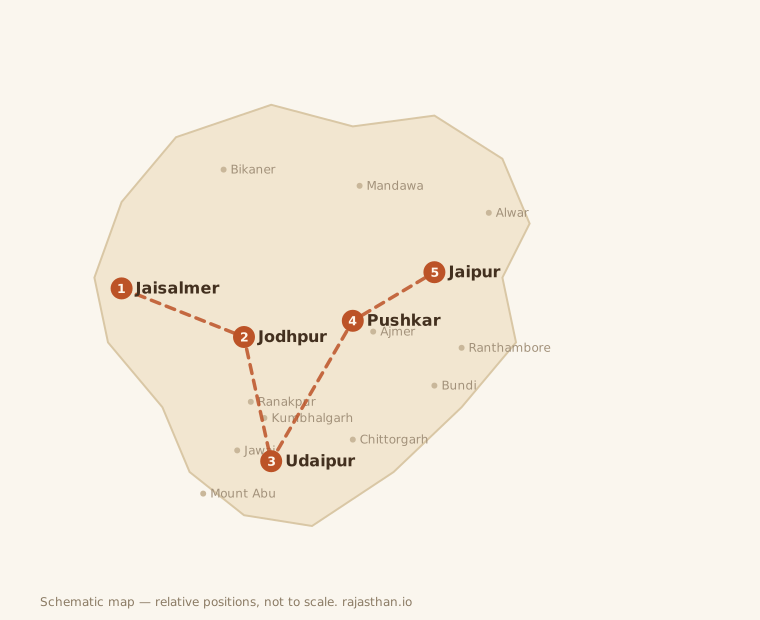
Geographically Pushkar sits almost exactly in the middle of the state, which is why it works so well as a hinge rather than a destination:
- From Jaipur: about three hours, which makes it the natural first stop heading west and a far better use of an afternoon than a six-hour push straight to Jodhpur.
- Onward to Jodhpur: roughly four to five hours, a comfortable morning drive.
- Onward to Udaipur: five to six hours, and a long day. Consider it only if you are skipping the desert entirely.
- Ajmer: just 13 km over the Nag Pahar ridge, but the road climbs and winds, so allow half an hour. The Dargah is one of South Asia’s most important Sufi shrines and is intensely busy; go covered, go early, and go with a guide or a local if you want to understand what you are seeing rather than simply be carried along by the crowd.
Pushkar earns its night on a 10-day route without argument. On a shorter trip it competes with a second night in Udaipur, and Udaipur usually wins — unless the fair is on, in which case nothing wins.
Where to stay
Guesthouses with lake-facing rooftops are the point — the north and east ghats have the pick. During the fair, tented camps bloom on the fairgrounds; elsewhere in the year, a heritage haveli near the bazaar keeps everything in walking range.
To be more specific about where in a very small town:
- North ghats and the lanes behind them. The classic Pushkar stay: small guesthouses, rooftops looking straight down at the water, temple bells at dawn whether you wanted them or not. Rooms are simple. Access is on foot.
- Bazaar end / Sadar Bazaar. Heritage havelis with courtyards, more comfort, thirty seconds from the shopping and two minutes from the ghats. Noisier by day, quieter at night.
- The outskirts towards the fairground and Ajmer road. Resorts, pools, camel-camp aesthetics and space for a car. Right for families and for anyone arriving during the fair; wrong if you wanted to walk out of your door into the town.
Cars cannot reach much of the old centre, so wherever you book, expect the last few hundred metres on foot with your bag.
Getting there and around
The nearest airport is Kishangarh (about 40 km), with a handful of domestic routes; Ajmer Junction, 13 km away, is the railhead, with good connections from Delhi, Jaipur and Ahmedabad, and a taxi or shared jeep over the hill from there. Pushkar’s own small station handles limited services and is not worth planning around. By road, Jaipur is about three hours on good highway.
Inside the town, walk. The centre is roughly a kilometre end to end, largely pedestrianised, and there is nothing you cannot reach on foot except the fairground and the base of the Savitri climb. See getting around Rajasthan for how the wider legs connect.
Common mistakes
- Accepting a flower at the ghats without deciding first. It commits you to a ceremony and a “donation” that will be negotiated upward. Say no early and warmly.
- Photographing people bathing. These are religious ablutions, sometimes funerary. Photograph the architecture and the birds, not the faces.
- Turning up in fair week without a booking. Rooms sell out months ahead and prices multiply. This is the one date in Rajasthan where winging it fails.
- Assuming last year’s fair dates. Kartik Purnima moves (in 2026 it falls nearly three weeks later than in 2025); verify for your year.
- Expecting a beer with sunset. There isn’t one, anywhere in town, and asking around for it marks you out.
- Giving Pushkar a two-hour stop. The ghats at dawn or dusk are the whole point, and a lunchtime pass-through gets you neither.
Questions people actually ask
Is Pushkar worth a night, or can I stop for lunch? Worth a night. The town is at its best in the hour after sunrise and the hour around sunset, and a daytime stop hits neither. If you genuinely cannot spare the night, stop in the late afternoon and drive on after dark.
Do I have to visit during the Camel Fair? No — and for many travellers the quiet version is the better one. The fair is extraordinary, but it turns a small contemplative town into a city of several hundred thousand people. Go for the fair if the spectacle is the reason you came; otherwise come in December or January when the lake is calm.
How should I dress? Shoulders and knees covered at the ghats and in temples, shoes off well before the water’s edge, and nothing that needs constant adjusting when you sit down. Pushkar’s traveller scene is relaxed about clothing in the cafés and not at all relaxed about it at the lake.
When is the best time to come? October to March. November brings the fair and the biggest crowds; December and January are cold at night and beautifully clear by day; March is the last comfortable month. See the best time to visit Rajasthan for the full picture.