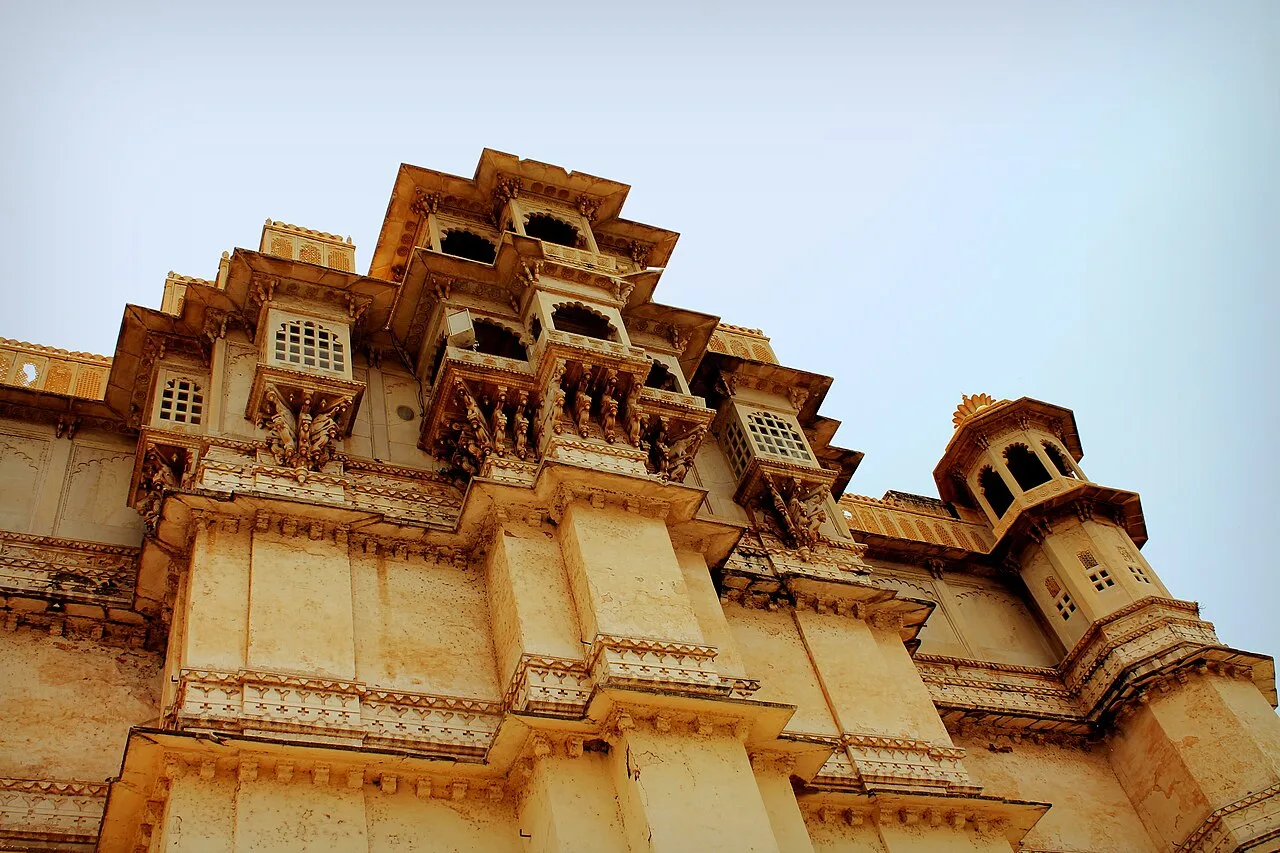
Jag Mandir, Udaipur: The Lake Garden Palace
Of Lake Pichola’s two island palaces, one — the Lake Palace — you can only admire from the water unless you’re a hotel guest. The other, Jag Mandir, is the one you can actually walk: a 17th-century garden palace of marble pavilions and stone elephants floating on the lake’s southern reach. The boat ride out is the signature Udaipur experience, and this guide covers exactly how it works.
The story: a refuge that inspired an empire
Jag Mandir predates its glitzier neighbor by two centuries. Begun under Maharana Karan Singh and completed by Jagat Singh I (whose name it carries), the building programme ran across roughly three decades in the first half of the 1600s.
Its most famous chapter came in the 1620s. The Mughal prince Khurram, in open revolt against his father Jahangir, needed somewhere beyond imperial reach, and Mewar — the one Rajput house that had held out longest against the Mughals — gave him refuge. He and his household stayed on this island as guests of the Maharana, lodged in the domed pavilion now called Gul Mahal. Khurram later became Shah Jahan, and tradition holds that the island’s pietra dura inlay and its dome lodged in the memory of the man who went on to build the Taj Mahal.
That last connection is worth stating carefully, because guides often deliver it as settled fact. The refuge itself is solid history. The architectural inheritance is tradition, repeated for centuries and entirely plausible given what Khurram saw here — but not something any surviving document proves. It is a good story that happens to sit on top of a true one, and you lose nothing by knowing which is which.
The island’s other historical turn is fully documented and, in its way, more affecting. During the 1857 uprising, the Maharana of Udaipur sheltered European residents and families who had fled the fighting, housing them on Jag Mandir where the water made the island defensible. For several months a garden palace built for a rebel Mughal prince served as a refuge again, for people on the opposite side of a different conflict. Guides tell this story on the island itself; it is one of the few places in Rajasthan where a building’s second act is as interesting as its first.
What’s on the island
It’s compact — an unhurried hour covers it all. Here’s roughly how that hour divides:
- The elephant jetty (10 minutes). Eight carved stone elephants guard the landing — the front-page photo of every Udaipur album. Most people spend longer here than they plan to, because the boat pulls in facing them and everyone stops.
- Gul Mahal (15 minutes), the domed sandstone pavilion that was the original refuge, with its marble inlay and its ring of small chambers. This is the oldest structure on the island and the one the whole story hangs on.
- The garden courtyard (15–20 minutes) — frangipani, palms, marble chhatris and the manicured lawns that make the island a wedding-venue A-lister. Occasionally sections close for events; evening functions don’t affect day visits, but a heavily set-up lawn does change the atmosphere.
- The café-restaurant (30–45 minutes if you stop) with palace-view tables — drinks facing the City Palace across the water are the civilized move, and the single best-value part of the trip in terms of what you get per minute spent.
- The Darikhana terrace and exhibition rooms (10–15 minutes) round out the circuit, with photographs and panels covering the island’s history and its restoration.
Budget one hour for the island if you’re moving steadily, 90 minutes to two hours if you sit down for a drink. There is no route to follow and no ticket queue once you land — you simply walk it.
How the boat trip works
Boats leave from the City Palace jetty (Rameshwar Ghat), which sits inside the City Palace complex. This is the detail that trips people up: you need a City Palace grounds ticket to reach the jetty at all, on top of the boat ticket itself. Two separate purchases, and the grounds ticket is distinct from the palace museum ticket, so decide in advance whether you’re doing the museum the same day — most people should, since you’re paying to walk in regardless.
Boat tickets are sold by departure slot, with departures running through the day. The trip is sold as a lake cruise that circles past the Lake Palace and the ghats before docking at Jag Mandir; you disembark, explore freely, and return on a later boat. Some cheaper tickets are cruise-only and don’t include landing on the island — check which you’re buying.
Two decisions to make:
- Standard vs. sunset departure. The late-afternoon “sunset” boats cost more and earn it. The City Palace’s lake facade faces west, so the afternoon sun lights it directly while morning leaves it flat and shadowed — you cruise back toward a palace lit gold, then amber, then lamplit. Midday is the opposite trade: hotter, harsher light, a washed-out lake, but fewer people and easier tickets. If you take one boat ride in Udaipur, make it the late one.
- How long on the island. An hour suits most; add thirty for a drink at the café. Check the last return boat time when you land — it matters in the shorter winter days, when the light goes before six.
Sunset slots are the first to sell out, particularly between November and February. Buy earlier in the day rather than turning up at four expecting a seat.
Photographing Jag Mandir
Four angles are worth planning for:
- The approach. From the boat, the row of stone elephants with Gul Mahal’s dome rising behind them. Sit on the right-hand side going out.
- The island’s north terrace. The full City Palace facade rising straight out of the water, with the Aravallis behind. In the late afternoon the sun is behind you and the whole wall of the palace glows — this is the definitive Udaipur photograph and the reason to go late.
- Mid-lake, on the return. The Lake Palace sits alone on the water with the old city behind it. You can’t land, but the boat passes close.
- From the western shore. Ambrai Ghat and the restaurants along that bank give you Jag Mandir and the City Palace together at sunset — the shot of the island itself, which you obviously can’t take while standing on it. Do the boat one evening and the west bank the next.
A wide lens earns its place on the boat; the island is too small to need reach.
Jag Mandir vs the Lake Palace
Visitors regularly conflate the two, and then feel short-changed. The distinction:
| Jag Mandir | Lake Palace (Taj Lake Palace) | |
|---|---|---|
| Built | 17th century | 18th century, as Jag Niwas |
| Access | Open to visitors by boat | Hotel guests only |
| What you do | Walk the gardens, eat, look back at the city | Admire it from the water |
The Lake Palace is the white one everyone has seen in photographs and films. It is a functioning luxury hotel, and boarding is restricted to guests and to diners with confirmed reservations — turning up by boat is not an option. Jag Mandir is the larger, older, greener island to the south, and it is the one the phrase “visiting the island palace” actually refers to. Every lake cruise passes the Lake Palace closely; that is as near as most people get, and it photographs beautifully from there.
Practicalities
- Time needed: 2 to 2.5 hours door-to-door from the palace jetty.
- When: late afternoon, unarguably. Midday boats are hotter and flatter of light; mornings are quietest if solitude beats sunset for you.
- Tickets: City Palace grounds ticket plus a separate boat ticket. Carry cash as a fallback.
- Monsoon and water levels: high water and rough lake conditions occasionally suspend boats in July and August; at the other extreme, after a weak monsoon the lake can drop far enough by late spring to disrupt services. Pichola is at its fullest and most photogenic from about August through November. Either way, if the season looks uncertain, do the trip on your first available day rather than saving it for last.
- What to bring: sun cover for the open boat, a light layer for the return in winter, and something over the shoulders if you’re stopping to eat. There’s no shade on the water.
- Combine with: City Palace in the morning, boat in the late afternoon, and the Bagore ki Haveli dance show after — the perfect Udaipur day, laid out hour-by-hour in our 3-day itinerary and compressed into the one-day version.
Is it worth it?
Yes — with the right expectations. You go for the ride and the views as much as the island: Udaipur assembled around you in one slow pan, the city’s whites and the Aravallis’ blues from lake level. As a monument, Jag Mandir is a graceful hour; as an experience, the sunset return is the single image of Udaipur you’ll keep.
Where it disappoints is when people arrive expecting the Lake Palace, or expecting a museum-dense site to fill an afternoon. It is a garden, a pavilion, a story and a view. Judged as that, it is among the best two hours in Rajasthan.
Full city context in the Udaipur guide; if you’re choosing which day to spend on the lake, the seasonal guide covers water levels and light through the year, and the day trips to Kumbhalgarh and Chittorgarh are what most people build around it.