Jaisalmer Travel Guide: The Golden Fort
Jaisalmer asks more of you than any other Rajasthan stop — it’s far from everything, deep in the Thar near the Pakistan border. It repays the journey with two things nowhere else offers: a living medieval fort where a quarter of the old city’s people still reside, and a night on the dunes under desert stars. Don’t come for less than two days; the travel math won’t forgive it.
The city exists because of trade. Founded in 1156 by the Bhati Rajput ruler Rawal Jaisal, it sat on the caravan route between India and Central Asia and grew rich taxing what passed. When sea freight and then Partition closed those roads, Jaisalmer became a garrison town at the end of the line — which is precisely why its medieval fabric survived intact instead of being redeveloped.
Sonar Qila: the golden fort
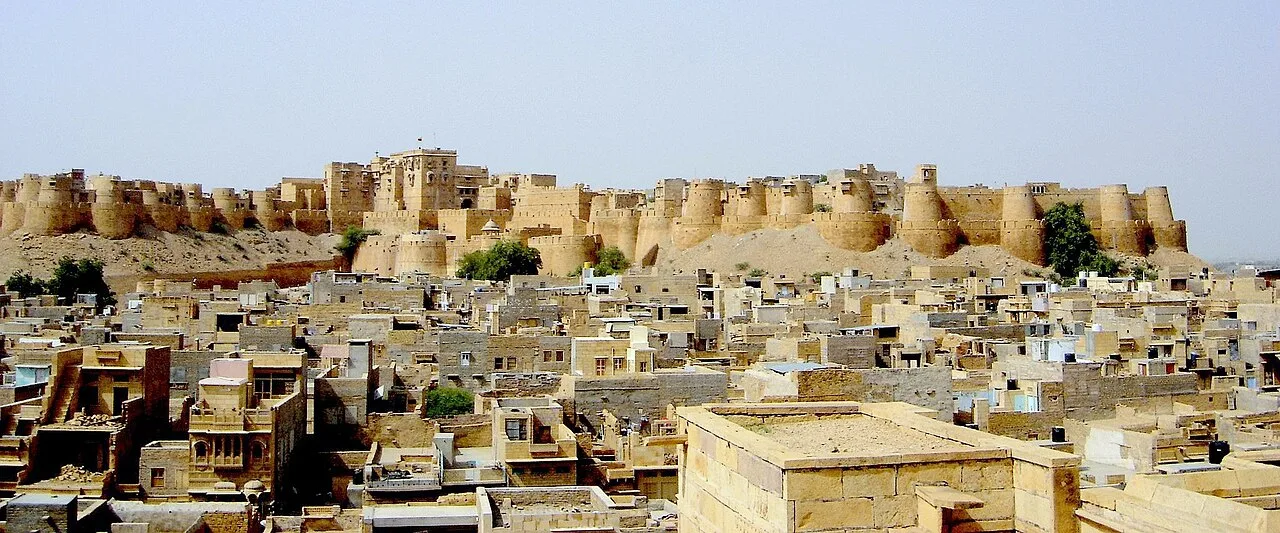
Unlike Jaipur’s or Jodhpur’s museum-forts, Jaisalmer Fort is a functioning neighborhood — homes, temples, guesthouses and cows share the lanes inside 99 bastions of yellow sandstone that turn honey-gold at sunset. Wander without a plan: the fort is small enough to get lost in pleasantly.
You climb in through four successive gates to Dashera Chowk, the main square, where the seven-storey fort palace museum earns an hour — take the audio guide, and go up for the rooftop, which is the only place you see the fort whole. The cluster of Jain temples (12th–15th century, carved like lacework) earns another hour and is the finest thing inside the walls; the interlinked shrines and the old manuscript library reward slow looking. Two practical points: the temples open to non-worshippers for a limited window in the morning, so build the day around them rather than dropping in, and leather is refused at the door — belts, bags, camera straps, all of it. Leave it at your hotel.
One conscience note: the fort’s drainage was never built for modern water use, and seepage damages the foundations. Many travellers now choose to stay outside the fort and visit by day — the town below has better havelis anyway. Eating and drinking inside is fine; sleeping there for three nights with a shower is what the medieval plumbing cannot absorb.
The havelis: merchant money made stone
Jaisalmer’s merchants built mansions that out-carve the palaces. Patwon ki Haveli — actually five houses in one lane, built by a family of brocade and jewellery traders — is the showpiece; the façade alone justifies the town, and only part of the complex is open, which is enough. Salim Singh ki Haveli, the peacock-roofed one, belonged to a prime minister remembered locally as anything but benign; its upper storey flares outward over thirty-eight balconies. Nathmal ki Haveli was carved by two brothers working one side each, and the halves don’t match — stand back and compare them, it’s the best five minutes in the old town.
Together they make an easy half-day walk through lanes where stone-carvers are still working. Allow about two hours if you go inside one, plus time to look up.
Gadisar Lake and the quiet hours
The 14th-century reservoir that kept the city alive is now its calmest corner — temple-ringed, catfish-swirled, best at dawn when the sandstone gate glows and the town still sleeps. Take the thirty minutes; it’s the closest Jaisalmer comes to Udaipur. The ornate archway you pass under, Tilon ki Pol, comes with a long-told story about a courtesan who paid for it and topped it with a shrine so that no offended ruler could pull it down.
Beyond the town
- Bada Bagh, six kilometres north — royal cenotaphs on a ridge, magnificent in late light, and now framed by wind turbines. Some people find that ruins it; others think the collision is the most honest image of modern Rajasthan. Forty minutes.
- Kuldhara, eighteen kilometres south-west — a Paliwal Brahmin village abandoned in the nineteenth century and left standing. The tour-guide framing is a curse and a ghost story; the likelier history is ruinous taxation under a local official, which is a sadder and more interesting thing to walk through. Go for the archaeology, not the shudder.
- Lodhruva, fifteen kilometres north-west — the Bhatis’ capital before Jaisalmer, now little more than a beautifully carved Jain temple in the scrub. For temple architecture enthusiasts only.
- Desert National Park — the last real stronghold of the critically endangered Great Indian Bustard. A serious birding half-day, and one of very few places on earth to see the species. Not a substitute for a dune sunset.
The desert night: how to choose
The dunes most camps use are at Sam (45 minutes west, bigger dunes, bigger crowds) or Khuri (quieter, more village-like). The honest advice:
- Pick the camp for its size, not its stars. Twenty tents means quiet; two hundred means a wedding-style buffet with a DJ. Decide which trip you’re on.
- Camel at sunset, jeep the rest. An hour by camel is romance; three is chiropractic.
- Winter nights are genuinely cold — near freezing in December–January. Pack proper layers; the “unlimited blankets” promise gets tested. Our packing list covers what desert nights actually require.
- Ask where the camp sits. “Sam dunes” in a listing can mean a tent on the sand or a compound on the road twenty minutes short of it. Ask directly.
- Skip the dune-bashing jeep safari unless you specifically want it — it is loud, it churns the dunes, and it is the opposite of why you came.
- One night is perfect. Two is sand in everything.
How many days?
Two in town plus the dune night is the sweet spot.
| Day 1 | |
|---|---|
| Morning | Fort: Jain temples first while they’re open, then the palace museum |
| Midday | Lunch on a fort rooftop, out of the sun |
| Afternoon | Havelis on foot through the old town below |
| Sunset | Bada Bagh cenotaphs, or the fort ramparts from the west side |
| Day 2 | |
|---|---|
| 06:30 | Gadisar Lake at first light — the reason to set an alarm here |
| 09:00 | Kuldhara, or the market lanes if you’d rather not drive |
| 15:00 | Leave for the desert camp |
| 17:00 | Camel out to the dunes for sunset, then camp, dinner and stars |
Our 3-day Jaisalmer plan has the details, and the Jodhpur–Jaisalmer route sets out how the two cities pair.
Where to stay
Below the fort, in the old town around the havelis, is the best base for most people: walkable to everything, rooftops facing the golden walls, and none of the drainage guilt. Inside the fort is atmospheric and the ethical question above is real — if you do it, one night rather than three. Around Gadisar Lake is quieter and greener, five minutes by auto from the fort gate. The highway hotels on the Jodhpur side are for people with an early train and no other requirement.
Then there’s the desert camp, which is a separate booking and the one worth spending on. A small camp with proper bedding and a cook beats a large one with a stage, every time.
Getting there — plan this first
This is the stop that shapes the whole route. From Jodhpur it’s about a 5-hour drive or a 5–6 hour train; overnight trains also run from Jaipur and Delhi. The small airport has seasonal winter flights and is not something to build a plan around.
Jaisalmer is a dead end in road terms — there is nothing beyond it but the border, so you backtrack east to continue anywhere. That single fact is why it’s the piece most 7-day trips cut and most 10-day trips keep.
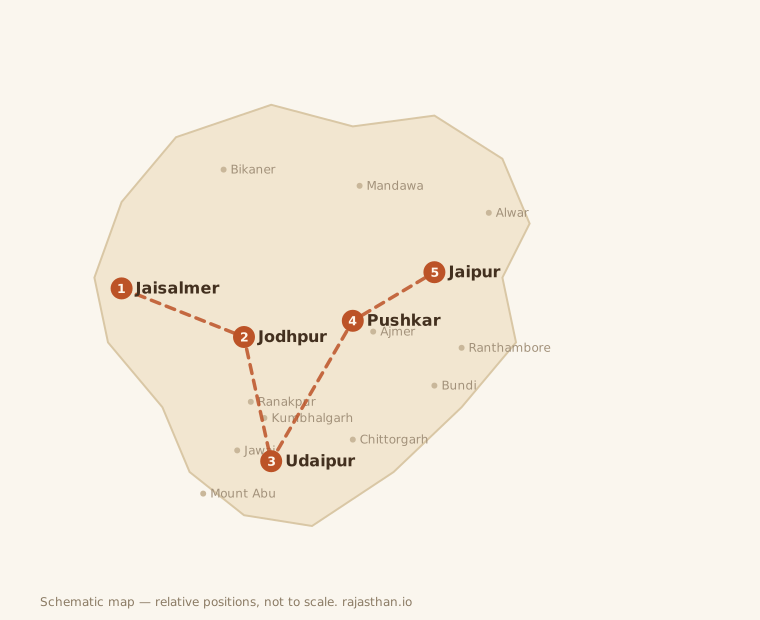
There are two sensible ways to absorb the backtrack. Return the way you came to Jodhpur and continue south to Udaipur; or loop north-east to Bikaner (about five hours) and rejoin the circuit from there, which trades a repeated drive for a genuinely different city. The 7-day circuit generally can’t afford either — if a week is all you have, Jaisalmer is the honest thing to drop.
What Jaisalmer tastes like
Desert cooking is built around what keeps. Ker sangri — a wild berry and bean stew, sun-dried and revived with spice — is the dish that belongs to this corner of the Thar more than anywhere else. Add gatte ki sabzi, dal baati churma, and, for a sweet, the local ghotua ladoo, which is gram flour and ghee and very little apology.
The market lanes below the fort sell mirror-work embroidery, patchwork and camel-leather goods, and the good stuff is genuinely good. Two cautions. Shopfronts selling “Kashmiri” carpets and pashmina are not selling Jaisalmer crafts, and the pressure-selling in some of them is heavy. And any tour-guide or camp operator steering you into a specific shop is being paid for it — buy where you wandered in yourself.
Mistakes to skip
- Coming for one night. With a five-hour approach at each end, a single night means you see the fort in a rush and skip the desert or vice versa.
- Wearing leather into the Jain temples. It will be refused, and the morning window won’t wait for you to go back and change.
- Underdressing for the camp. December and January nights approach freezing out on the sand. Fleece, hat, socks.
- Booking the cheapest camp. This is the one line item where price maps almost directly onto experience.
- Treating Kuldhara as a haunted attraction. It’s an abandoned village with a hard history, not a set.
Questions people actually ask
Is Jaisalmer worth the detour? If you have ten days, unquestionably — it is the most distinctive place in Rajasthan and nothing else resembles it. If you have seven, it forces a choice between the desert and Udaipur, and Udaipur usually wins on variety.
Train or drive from Jodhpur? The overnight train saves a day and a hotel night; the daytime drive shows you the desert changing, and lets you stop. If you’re carrying children or heavy bags, the train is easier.
Is it safe this close to the border? Yes. It is a garrison region with a visible military presence and ordinary tourism infrastructure. Some areas towards the frontier require permits; a local operator will tell you which.
Can I skip the camp and just do a sunset trip? You can — an afternoon camel ride at Sam and a drive back for dinner in town works. You lose the stars, which in the Thar are the actual point.
When to come
October to February, no contest. The desert in April–June is a furnace (45 °C days), and even March warms fast. February brings the Desert Festival — turban-tying contests, camel polo, folk music under the fort — book beds well ahead. December and January give you the clearest skies of the year and the coldest nights; see the best time to visit Rajasthan for the month-by-month picture.