Jaisalmer in 3 Days: Fort, Havelis & Desert Night
Jaisalmer is far from everything, so the trip only pays off if you plan the days properly. Three days is the honest minimum: two in and around the golden city, one built around a night on the dunes. Here’s how they fit together.
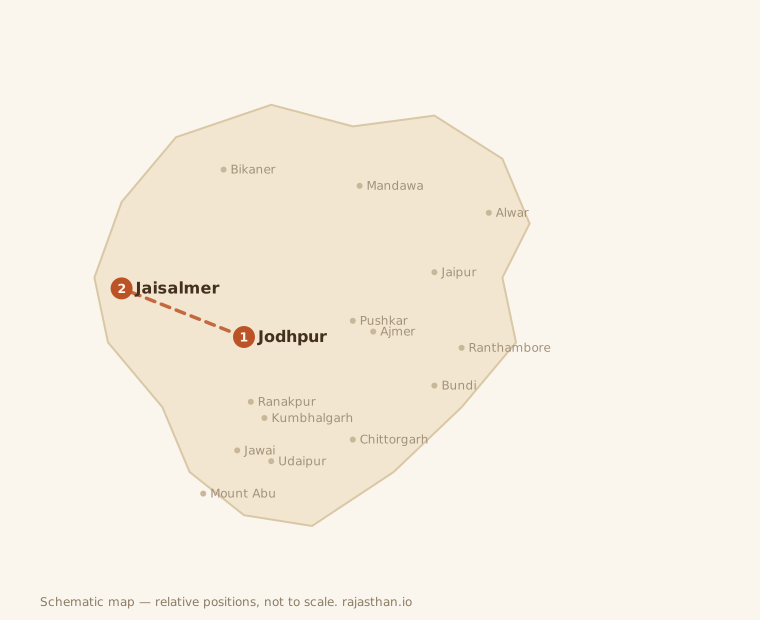
The thing to understand before you book anything is that Jaisalmer is a road dead-end. No highway loops onward from here — the border is 100-odd kilometres west and there is nothing to cross it for. Whatever you spend getting out, you spend again coming back east, and every sensible Jaisalmer plan is built around that fact. It is why two nights feels thin (you buy the travel and then leave immediately) and why four starts to feel indulgent unless you are genuinely into desert villages. Three is the number where the arithmetic works.
The shape of the trip
| Day | Where | Sleep in |
|---|---|---|
| 1 | Arrive from Jodhpur, Sonar Qila and the ramparts at sunset | Jaisalmer town, below the fort |
| 2 | Gadisar Lake, the merchant havelis, out to the dunes | Desert camp, Sam or Khuri |
| 3 | Dune sunrise, Bada Bagh or the bazaar, then east | Onward — Jodhpur or the train |
Two beds in three nights, and the second one is a tent. Note that the fort goes on Day 1 rather than Day 2: you want it at sunset, and you want it before the desert, because the citadel is the thing you will keep looking back at.
Day 1 — Arrival and the living fort
8:30–14:00 · Get here. Most travellers come in on the overnight train or the 5-hour drive from Jodhpur; the day trains take 5–6 hours and are comfortable and cheap. The road version lets you stop and watch the land change — scrub thinning to sand, cattle giving way to camels — which the sleeper does in the dark. The Jodhpur to Jaisalmer guide compares them properly.
14:00–16:00 · Check in, eat, let the heat pass. The fort is best late, and nothing is gained by climbing it at two in the afternoon.
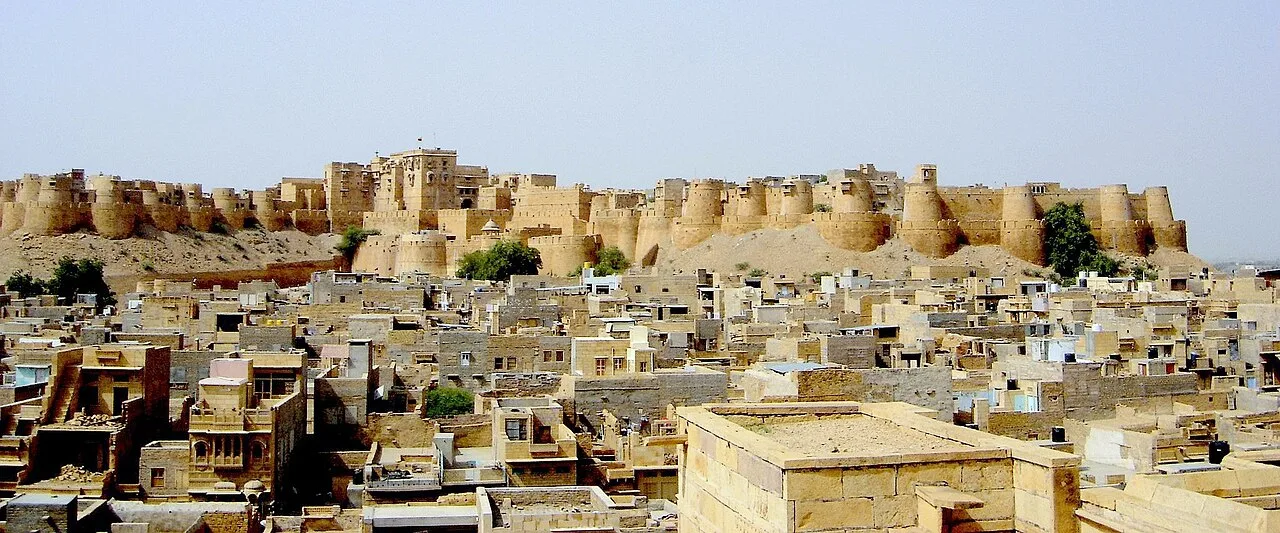
16:00–18:30 · Sonar Qila. Enter through the main gates and simply wander. Unlike Jaipur’s or Jodhpur’s museum-forts, a quarter of the old city still lives inside these 99 bastions — homes, temples, shops and cows sharing lanes barely wide enough for a motorbike, with laundry over ramparts that held off sieges. Visit the fort palace museum (about an hour, and the roof terrace is the reason) and the cluster of Jain temples, whose 12th–15th century carving is as fine as anything in Rajasthan. Leather is refused at Jain temples — belts, bags, camera straps — so leave it at the hotel rather than arguing at the door.
18:30–19:30 · Sunset on the ramparts. The whole point of the name: the yellow sandstone turns molten gold, then honey, then bronze, and the desert behind the town goes pink for about four minutes. Find a west-facing bastion and stay put.
Evening · Rooftop dinner in the town below, facing the lit fort. Floodlit from outside is a better view than being inside it, which is also the argument for where you sleep.
Day 2 — Havelis, lake, and out to the dunes
7:30–8:30 · Gadisar Lake at dawn. The 14th-century reservoir that kept this city alive, ringed with shrines, ghats and a carved gateway. Empty, cool, and the closest Jaisalmer comes to Udaipur’s serenity. Go before the town wakes; by ten it is boats and touts.
9:30–12:00 · The merchant havelis. Jaisalmer sat on the caravan route to Central Asia, and its traders out-carved the royals. Patwon ki Haveli — five mansions in one lane, built by one family of brocade and opium traders — is the showpiece, and the interiors are worth the ticket for the mirrorwork and the view down onto the lanes. Add Salim Singh ki Haveli, the peacock-roofed one, whose overhanging upper storey looks structurally implausible and is, and Nathmal ki Haveli, carved by two brothers working from opposite ends so that the two halves nearly match. It is an easy two-hour walking loop, all within the old town below the fort.
12:00–15:00 · Lunch and shade. Shop the bazaar for mirror-work textiles and camel leather if that appeals; otherwise rest. The desert afternoon is coming and it is longer than it looks on paper.
15:30 · Drive to the dunes. Sam is about 45 minutes west — bigger dunes, more camps, considerably busier, with jeep convoys at sunset — while Khuri is quieter and more village-like. Choose your camp for its size above everything else: twenty tents means silence, two hundred means a buffet with a DJ. Ask the number before you ask about the bathroom.
17:00–18:30 · Camel to a dune crest for sunset. One hour on a camel is romance; three is a chiropractic event. Book the short ride, and walk the last dune on foot — the sand is better without a saddle under you.
Evening · Camp night. Folk musicians, dinner under a genuinely dark sky, and the quiet after everyone goes to bed, which is the actual reason you came. In December and January it gets close to freezing after dark — bring real layers, not optimism. The packing list is blunt about this because people get it wrong every winter.
Day 3 — Sunrise, and the road out
6:30–7:30 · Dune sunrise. Worth the alarm; the light comes up clean across the sand and the camp is still asleep. Walk out beyond the last tent so the generators are behind you.
9:00–10:00 · Drive back to town. From here it depends on your onward transport:
- Continuing to Jodhpur or beyond: leave by late morning. Jaisalmer is a road dead-end — you’ll backtrack east whatever your next stop is, and it is about 5 hours to Jodhpur. If your next stop is Udaipur, that is ~9 hours with stops and you should skip the dune sunrise, or accept arriving after dark.
- Extra half-day in town: visit Bada Bagh, the royal cenotaphs on a ridge outside the city — best in the golden hour, but empty and atmospheric mid-morning too — or the Desert Culture Centre museum, or Vyas Chhatri for a last look at the fort across the rooftops.
Where you sleep
- Night 1 and, if you have it, night 3 — the town below the fort, not inside it. The fort’s medieval drainage was never built for modern water use and seepage is damaging the foundations; many travellers now stay in the town havelis and visit by day. The views of the fort are better from outside anyway, and the sandstone guesthouses down the hill have the same courtyards and better plumbing.
- The lanes around Patwon ki Haveli and Gandhi Chowk put you five minutes from the fort gate and inside the walkable old town — this is the block to aim for.
- Night 2 — a small camp at Sam or Khuri. Khuri if you want quiet, Sam if you want the big dune fields and do not mind sharing them. The difference between a good desert night and a bad one is almost entirely camp size.
- The luxury tented resorts outside town are a different holiday: lovely, insulated, and further from the sand than they look in the photographs.
What to cut, what to add
Only two days? Keep the desert night and compress the city: fort at sunset on arrival day, havelis in the morning, dunes that afternoon, and out the next morning after sunrise. You will skip Gadisar Lake and the bazaar. Do not cut the camp to save a day — a Jaisalmer trip without a desert night is a long drive to look at sandstone.
A fourth day? Two good uses. Kuldhara, the abandoned Paliwal village on the Sam road, is a genuinely strange hour — a whole settlement deserted in the early 19th century and left standing. Or Lodhruva, the older capital north-west of town, where a Jain temple sits in the ruins of the city Jaisalmer replaced. Both are half-day trips at most, which is why three days remains the recommendation.
Coming with more time overall? Jaisalmer sits best in a longer western loop with Bikaner to the north, which lets you approach the desert from one direction and leave in another instead of retracing the Jodhpur road twice.
Common mistakes
- Sleeping inside the fort. Beyond the conservation problem, you are paying for a view you cannot see, because you are standing in it.
- Booking the biggest, cheapest camp. Amplified music, two hundred tents and a jeep park is not a desert night. Ask the tent count.
- Booking the three-hour camel safari. Nobody has ever finished one and wished it were longer.
- Arriving on the overnight train and going straight to the dunes. You will be asleep by the campfire. Give the fort your first evening; it is what the city is named for.
- Treating Jaisalmer as a day trip from Jodhpur. Ten hours of driving for an afternoon. If you cannot spare the nights, skip it — which is exactly why the 7-day circuit leaves it out.
- Coming in May. The Thar reaches 45 °C and the desert night stops being the reason you came.
Practical notes
- Getting here: overnight trains from Jodhpur, Jaipur and Delhi; the 5-hour drive from Jodhpur; and a small airport with seasonal winter flights whose schedule changes year to year — check before you build a trip around it. Full city detail in the Jaisalmer guide.
- When: October to February, firmly. December and January give you the clearest light and the coldest nights; February is the sweet spot. March warms the Thar fast, and April–June reaches 45 °C, at which point the dunes are survival rather than romance. Monsoon brings occasional rain and a lot of humidity without much relief — the desert is the one part of Rajasthan the rains do not improve. See the best time to visit guide.
- February brings the Desert Festival — camel polo, turban-tying, folk music under the fort. Book beds well ahead; the town fills. Dates move with the lunar calendar, so check the festivals guide.
- Cash and connectivity thin out as you go west. Sort both in town before you head to the dunes.
Questions people actually ask
Sam or Khuri? Khuri if silence matters more than scale; Sam if you want the classic big dune field and are willing to share it. Sam is about 45 minutes west of town and has far more camps; Khuri is smaller and feels closer to a village than a resort strip.
Is the overnight train worth it over the drive? It saves a day and a hotel night, which on a dead-end route is real money. The trade is that you arrive tired and you miss the landscape changing. If this is your only desert trip, drive at least one direction.
Is one night in the desert enough? Yes, for almost everyone. You get the sunset, the night sky and the sunrise, which is the whole product. A second night is for photographers and people who want a longer camel ride, and neither of those is most people.
Can I skip Jaisalmer and still say I’ve seen the Thar? Honestly, no — Jodhpur’s nearby dunes are a thin substitute. But the right answer to “I don’t have the days” is to skip it cleanly rather than compress it. Jaisalmer slots into the 10-day Rajasthan route after Jodhpur, where there is room to pay for the backtrack, and the 7-day circuit deliberately skips it, because forcing the desert into a week wrecks the pacing.