Where to Stay in Jaisalmer + Desert Camps
Jaisalmer accommodation splits into two separate decisions, and most people only think about the first one. Where you sleep in town matters. Which desert camp you book matters more, because that is the night people either talk about for years or quietly regret.
Start with the town, because it is quicker.
The four town options
| Area | Suits | Relative cost | Walk to fort gate | The catch |
|---|---|---|---|---|
| Below the fort | Almost everyone | Budget to splurge | 5–15 min | Nothing serious |
| Inside the fort | Atmosphere seekers | Budget to mid | You live in it | The drainage problem |
| Gadisar Lake | Quiet, longer stays | Budget to mid | 15–20 min | Away from the lanes |
| Highway hotels | Very early departures | Budget to mid | Needs transport | No reason otherwise |
The town below the fort — the right base
Who it suits: effectively everyone.
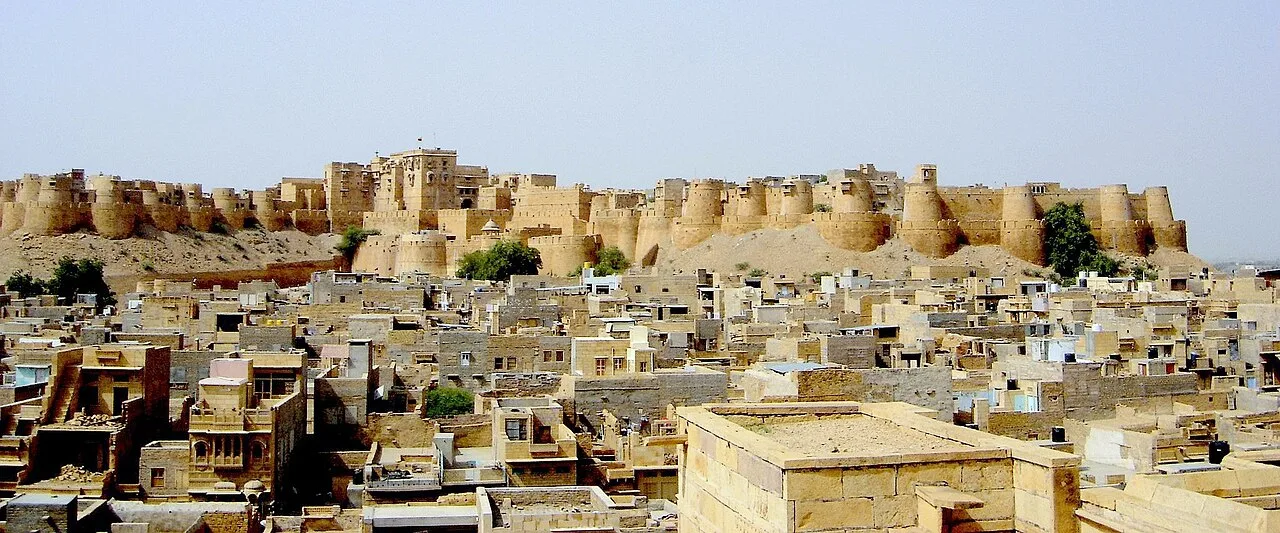
The streets spilling down from the fort gate hold most of Jaisalmer’s good accommodation, including the carved sandstone havelis that give the town its reputation. You are minutes from the fort on foot, the restaurants are here, the camp operators and travel desks are here, and — the practical point — the rooftops in this area look at the fort, lit up at night, which is a better view than anything available from inside it.
Cost: the full spread. Cheap, clean guesthouses through to a handful of serious haveli conversions.
The trade-off: honestly, very little. The lanes are narrow, some approaches are stepped, and a hard suitcase is a nuisance — that is the extent of it.
Inside the fort — atmospheric, and there is a conscience question
Jaisalmer Fort is one of the very few living forts left anywhere: several thousand people live inside the walls, and a scattering of guesthouses and restaurants operate among them. Waking up inside is a genuinely extraordinary experience, and the lanes at 6 am before the day-trippers arrive are worth seeing.
Here is the part you should know before booking. The fort sits on a soft sandstone bluff and was built for a population with minimal water use. Modern plumbing put far more water through it than the structure was designed to shed, and seepage has been undermining the foundations for decades — bastions have collapsed, houses have been lost, and conservation bodies have listed the fort as at risk more than once. Drainage systems have been installed and improved over the years, and the situation is better than it was, but the underlying pressure is the number of people, showers and restaurants operating inside a medieval structure that cannot drain them.
That is the case. Sleeping inside adds to it; sleeping below does not. Plenty of thoughtful travellers stay in the fort anyway, and the families running those guesthouses depend on the income, so this is not a simple moral arithmetic. But you should make the choice knowing what it is, rather than discovering it afterwards.
A middle path that works: stay below, and spend your evenings inside. Eat at a fort restaurant, walk the ramparts at sunset, visit the Jain temples in the morning. You get almost everything the fort offers except the shower.
If you do stay inside: the practical trade-offs are real too — small rooms, weak water pressure, no vehicle access, luggage carried up by hand, and day crowds outside your door from mid-morning.
Around Gadisar Lake — quiet and green
Who it suits: longer stays, early risers, anyone who found the fort lanes overwhelming.
The lake sits a short walk south-east of the fort and is the one genuinely green corner of Jaisalmer — chhatris on the water, birds at dawn, and more air than the old town. Accommodation here is mid-range and quiet.
The trade-off: fifteen to twenty minutes’ walk from the fort gate, which is nothing in December and an unpleasant amount at 4 pm in May. Little to walk to for dinner.
Highway hotels — one reason only
Larger properties sit on the approach roads out of town, usually with a pool and a garden, serving tour groups and very early departures. Book one only if you have a dawn train or a long drive east. Otherwise you are twenty minutes from the only thing you came to see, to save very little.
Choosing a desert camp — the decision that matters
Nearly everyone in Jaisalmer spends a night out in the Thar. This is where the quality range is enormous, and where the marketing is least reliable.
Sam vs Khuri
Sam (Sam Sand Dunes) is the classic, about 40 km west. The dunes are higher, the sand is the postcard sand, and the infrastructure is fully developed — which is a polite way of saying that on a peak-season evening there can be hundreds of camel riders, dozens of jeeps and a row of camps within sight of each other. If you want the dramatic dune landscape and do not mind company, Sam delivers it.
Khuri, about 45 km south-west, is smaller, quieter and closer to village life. The dunes are lower and less photogenic. The evening is calmer, the camps are generally smaller, and there is more chance of the silence people imagine when they picture the desert.
Neither is remote. Both are a day’s tourist infrastructure built around dunes an hour from town. Anyone selling you “untouched wilderness” at either is selling you something.
Camp size is the single biggest quality factor
If you take one thing from this page: ask how many tents the camp has, and believe the number over every adjective in the listing.
- Around 10 to 20 tents — you get quiet. Dinner is a small group around a fire, the music is two or three musicians, and when it finishes you can actually hear the desert. Stars are visible because there is not much light.
- Around 40 to 60 tents — a busy but manageable middle. Buffet dinner, organised entertainment, some queueing.
- 150 to 200-plus tents — an events venue. Buffet lines, amplified music, frequently a DJ, generator lighting all night, and coach parties. It can be good fun. It is not a desert experience, and the difference in price from a 20-tent camp is often small.
Camps rarely advertise their capacity. Ask directly, and ask how many tents will be occupied on your date. A 60-tent camp in low season with eight guests is a different night entirely.
What “luxury camp” actually means
The word covers everything from a canvas tent with a proper bed to a permanent structure with air conditioning, a bathroom and a private deck. Broadly there are three tiers:
- Basic / Swiss tent — canvas, cot, shared or attached simple bathroom, blankets. Fine, and what most people book.
- Deluxe — attached bathroom with running hot water, better bedding, a chair outside. The usual sweet spot.
- Luxury / royal — larger permanent tents, air conditioning or heating, proper furniture, sometimes a private dining option. Worth it in the shoulder months when temperature control has real value.
The things that actually determine your night are not in that ladder: how far the camp is from the main dune cluster, how many people are at dinner, whether the tent has a hard floor, and whether hot water arrives at 6 am or only in the evening. Ask about those.
The winter night nobody prepares for
In December and January the Thar approaches freezing after dark. Days are mild and pleasant; the temperature falls off a cliff after sunset because there is no moisture in the air to hold the heat. Camps supply quilts and they are not sufficient on their own. Bring an insulated jacket, a thermal layer, warm socks and a hat — the packing list covers exactly this, and it is the most common serious discomfort visitors report from Rajasthan.
The reverse applies in April to June, when a tent at 3 pm is intolerable and only a camp with working air conditioning makes sense. Check the season with the best-time guide before you book anything in the desert.
Questions worth asking before you pay
- How many tents, and how many occupied on my date?
- Is the camel ride included, and how long is it? (Short rides to a dune and back are standard; long treks are a different product.)
- Is dinner buffet or served, and is there amplified music?
- Attached bathroom with hot water, or shared?
- What time is the jeep pickup from town, and is the return included?
- Is there heating or air conditioning, and does it run all night or only until the generator is switched off?
Which should you pick
- Two nights in Jaisalmer — both in the town below the fort, with the desert night as a trip out from there, or one night in town and one at camp.
- Three nights — town, camp, town. This is what the three-day Jaisalmer plan is built around.
- You want the fort experience without the guilt — stay below, eat and walk inside.
- You want quiet in the desert — Khuri, and a camp with under 25 tents.
- You want the big dunes and do not mind crowds — Sam, but still ask about camp size.
- Travelling in December or January — any camp, plus a real jacket.
- Arriving overnight from Delhi or driving in from Jodhpur — see the Jodhpur–Jaisalmer route and the transport guide; Jaisalmer is a road dead-end you have to backtrack out of, so plan the exit before you arrive.
When you search for a stay, search “Jaisalmer fort view” for rooftops facing the walls rather than “Jaisalmer fort”, which returns properties inside it. Some links here earn a commission at no extra cost to you — the disclosure is on the privacy page, and no camp or hotel has paid for a mention.
Jaisalmer FAQ
Is one night at a desert camp enough?
Yes for almost everyone. The appeal is sunset, dinner, stars and sunrise — a second night adds little unless you are doing a longer camel safari.
Can I book a camp when I arrive instead of in advance?
In low season, easily, and often better. From November to February, book ahead: the small camps fill first and what remains at short notice is the 200-tent end of the market. Budget for it with the trip cost framework.
Do I have to ride a camel?
No. Jeep transfers to the dunes are standard and camps are used to guests skipping the ride. If you do ride, keep it short — an hour is plenty, and a half-day is uncomfortable for most people.
Is it worth staying in Jaisalmer town at all, or just the camp?
Stay in town. The fort at night, the havelis, Gadisar at dawn and the Jaisalmer destination guide list of sights all need daylight hours, and camps are a long way from all of it.
Which is a better desert base overall, Jaisalmer or Bikaner?
Jaisalmer, comfortably, for dunes and atmosphere. Bikaner is the better stop for a fort and a camel research farm without the tourist volume, and it works well as a break between Jodhpur and Delhi rather than as a desert-night destination.